Let me start with something blunt.
Most businesses don’t have a “marketing problem.” They have a response problem.
Leads come in. Customers ask questions. Calls go unanswered. Follow-ups… forgotten.
And somewhere in that silence, revenue quietly disappears.
I’ve spent years inside systems like this - debugging CRM workflows, watching support queues pile up, listening to sales teams swear they’ll “call back later.”
They don’t.
Now here’s the shift: voice AI automation isn’t just improving communication—it’s replacing delay with immediacy.
And 2026? It’s the year that shift becomes impossible to ignore.
What Is Voice AI Automation?
Strip away the buzzwords.
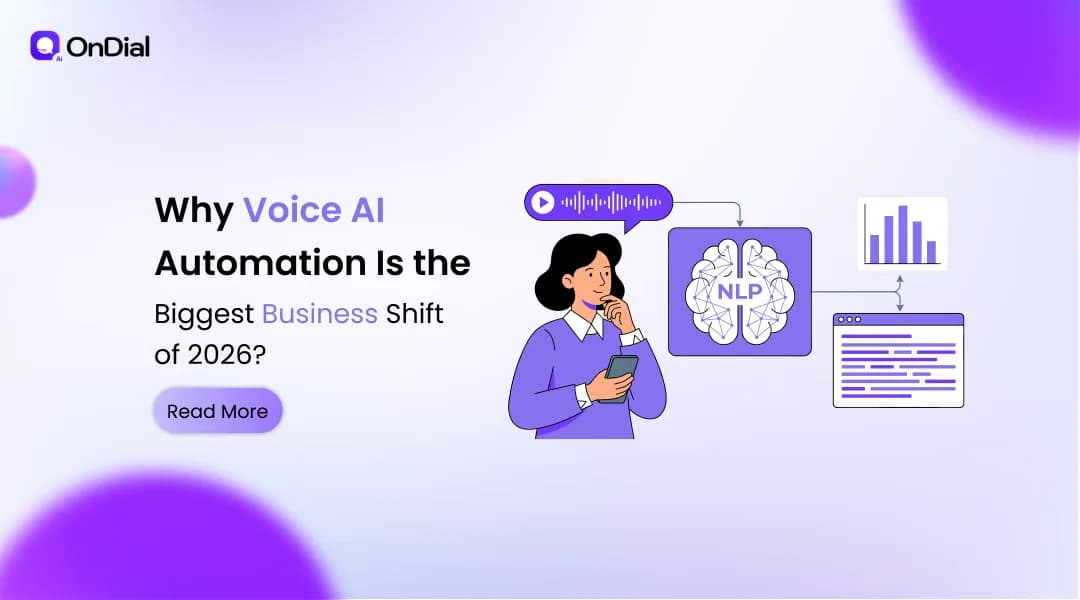
Voice AI automation is the ability for machines to handle real human conversations—over calls, in a way that feels natural, responsive, and context-aware.
Not robotic IVRs. Not “press 1 for support.”
I’m talking about AI voice agents that:
- Answer calls instantly
- Understand intent (not just keywords)
- Respond conversationally
- Execute tasks (booking, qualifying, resolving)
Think of it as a voice assistant, but built specifically for business workflows.
And yes, it remembers context. And yes, it learns over time.
Why 2026 Is a Turning Point for Businesses
Here’s the uncomfortable truth:
Most companies didn’t adopt voice AI earlier because it wasn’t good enough.
Accuracy issues. Awkward conversations. Customer frustration.
I’ve tested those early systems. They were… painful.
But something changed.
Three things, specifically:
1. Speech recognition got scary accurate
Accents, noise, mixed languages, it handles them better now.
2. Language models became context-aware
AI doesn’t just respond. It understands flow.
3. Infrastructure became affordable
What used to cost enterprise budgets is now accessible to SMEs.
So now we’re at an inflection point.
Not “early adoption.” Not “experimentation.”
Adoption. At scale.
Let me ask you something—
How many calls did your business miss last week?
That number? That’s your automation opportunity.
Key Benefits of Voice AI Automation
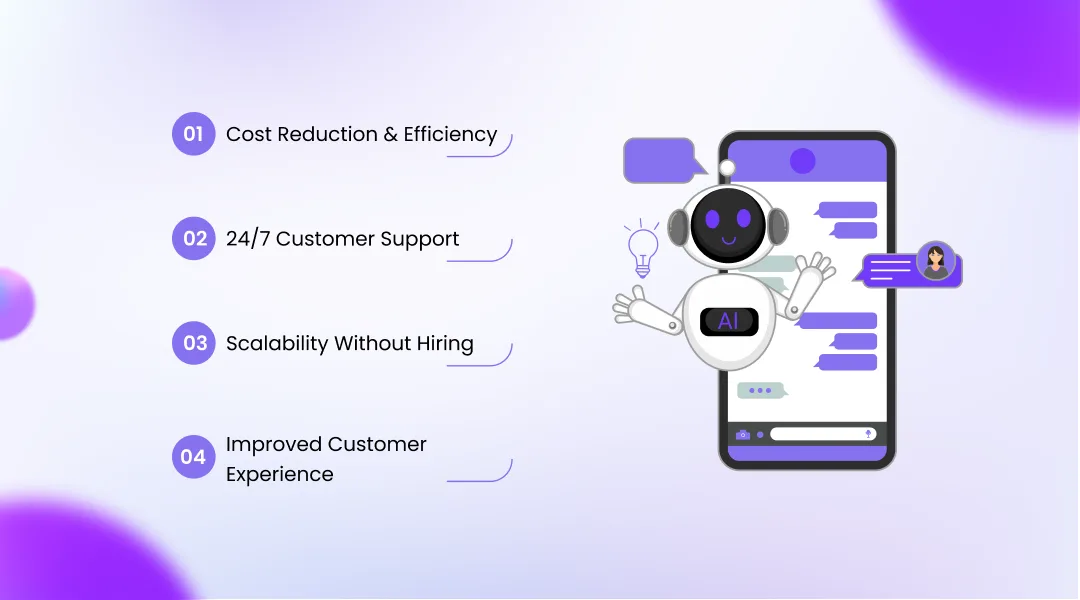
Cost Reduction & Efficiency
Hiring, training, managing, human teams are expensive.
And inconsistent.
Voice AI automation reduces:
- Call handling costs
- Repetitive task load
- Dependency on large teams
But here’s what people miss -
It doesn’t replace humans. It filters work so humans do better work.
24/7 Customer Support
Customers don’t operate during your office hours.
They call when they need help. Not when your team is available.
Voice AI doesn’t sleep. Don't take breaks. Don't miss calls.
And that alone changes customer expectations.
Scalability Without Hiring
Traffic spikes? No problem.
Product launch? Covered.
Festive season chaos? Handled.
With voice automation software, scaling isn’t about hiring faster.
It’s about responding faster.
Improved Customer Experience
Here’s where skeptics lean back.
“AI will ruin the human experience.”
Fair concern.
But let me flip it—
Is waiting 10 minutes on hold a good experience? Is repeating your issue to three agents better?
Voice AI, when done right, removes friction.
And friction is what customers actually hate.
Voice AI vs Traditional Chatbots: What’s Changed?
Chatbots had their moment.
And their limitations.
Typing is slow. Context gets lost. Engagement drops.
Voice changes the equation.
It’s:
- Faster
- More natural
- Emotionally expressive
And most importantly—
It mirrors how humans already communicate.
The gap between human and machine? It’s narrowing. Fast.
Top Use Cases of Voice AI in Business
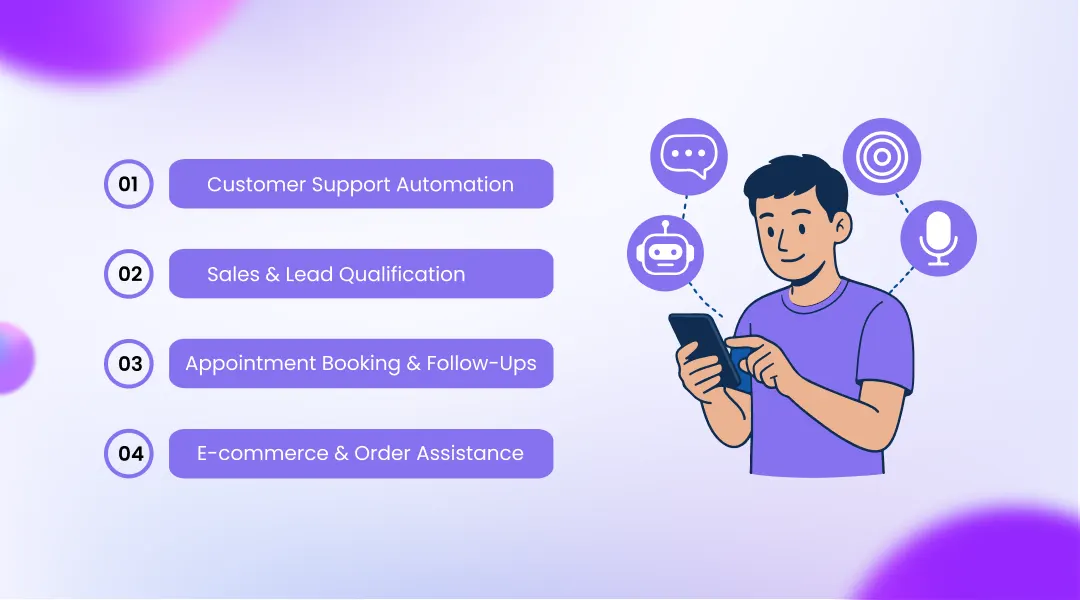
Customer Support Automation
Answer FAQs. Handle complaints. Route complex issues.
All without overwhelming your support team.
Sales & Lead Qualification
This one’s big.
Voice AI can:
- Call leads instantly
- Ask qualifying questions
- Score prospects
- Pass hot leads to sales teams
No delay. No drop-offs.
Appointment Booking & Follow-Ups
Missed appointments cost money.
Voice AI fixes that:
- Schedules calls
- Sends reminders
- Follows up automatically
Consistency wins here.
E-commerce & Order Assistance
Order tracking. Product queries. Returns.
Handled in seconds.
Not hours.
Real-World Examples of Voice AI Automation
I’ve worked with teams implementing these systems.
Here’s what actually happens:
- A healthcare clinic reduced missed appointments by 40%
- A D2C brand doubled lead response speed
- A real estate agency qualified 3x more leads without hiring
No hype. Just outcomes.
How Voice AI Is Transforming Industries
Voice AI for business isn’t limited to one sector.
It’s reshaping:
- Healthcare → appointment management, patient queries
- E-commerce → order support, upselling
- Real Estate → lead qualification
- Finance → customer verification, support
- Education → enrollment assistance
Different industries. Same pattern.
Communication bottlenecks… removed.
Challenges & Limitations of Voice AI
Let’s not pretend it’s flawless.
It isn’t.
1. Complex conversations can still break it
Edge cases exist.
2. Poor implementation ruins experience
Bad scripts = bad outcomes.
3. Trust takes time
Customers need to feel comfortable talking to AI.
And here’s the big one
If you treat voice AI like a shortcut, it will fail.
It’s not plug-and-play magic. It’s a system that needs thoughtful design.
Future of Voice AI Automation Beyond 2026
We’re just getting started.
What’s next?
- Hyper-personalized conversations
- Emotion detection
- Multilingual fluency at scale
- Deeper CRM integrations
And eventually -
You won’t be able to tell if you're talking to AI.
How to Implement Voice AI in Your Business
If you’re thinking about this seriously, start here:
Step 1: Identify repetitive call workflows
Support. Sales. Follow-ups.
Step 2: Define clear outcomes
What should the AI achieve?
Step 3: Choose the right partner
Not just tech. Strategy.
Step 4: Start small
Test. Learn. Improve.
Step 5: Integrate deeply
CRM, sales pipelines, support systems.
Companies focus heavily on tailored voice AI solutions, which matters more than most people think.
Because generic systems fail in real-world complexity.
Conclusion
Voice AI automation isn’t a trend.
It’s a correction.
A correction to slow responses. Missed opportunities. Broken communication systems.
And the businesses that understand this early?
They don’t just operate better.
They feel better to customers.
Let me leave you with this—
Speed is no longer a competitive advantage. It’s the baseline.
The real question is:
Are you keeping up… or quietly falling behind?