I’ll be blunt.
Most “AI in agriculture” solutions are built in cities… for people who’ve never stepped into a farm.
I’ve seen beautifully designed apps fail because farmers didn’t open them. Not once. Not twice. Ever.
But you know what they did respond to?
A simple phone call.
That’s where this entire conversation changes.
Because AI voice agents for agriculture aren’t trying to force behavior change. They’re adapting to what already works.
And that subtle difference? It’s everything.
What Are AI Voice Agents?
Let’s strip away the jargon.
An agriculture voice assistant is a system that can talk to farmers, over a phone call or voice interface, understand what they’re saying, and respond intelligently.
No typing. No apps. No learning curve.
Just… conversation.
It uses speech recognition, natural language processing, and automation under the hood. But the farmer doesn’t care about that.
They care about one thing:
“Can I ask a question and get a useful answer?”
If yes, you’ve got adoption.
If not, you’ve got another dead product.
Why Agriculture Needs AI Voice Technology
Here’s the uncomfortable truth.
Digital adoption in agriculture isn’t failing because farmers resist technology.
It’s failing because we keep building the wrong interfaces.
Let me ask you something:
If your entire livelihood depended on time-sensitive decisions… would you scroll through an app? Or just make a call?
Exactly.
Voice fits naturally into rural ecosystems because:
- Literacy levels vary
- Regional languages dominate
- Internet connectivity is inconsistent
- Farmers are already used to calling for advice
So instead of forcing farmers to adapt…
voice AI for farmers adapts to them.
That’s why AI farming solutions built on voice have significantly higher engagement rates compared to mobile apps.
Not because they’re smarter.
Because they’re simpler.
How AI Voice Agents Work in Farming
Alright, let’s demystify this.
At a high level, here’s what happens:
- A farmer calls a number (or receives a call)
- The AI understands the spoken query (in their language)
- It processes the intent
- It fetches or generates a response
- It replies instantly, like a human would
Sounds simple. It’s not.
(Trust me, I’ve seen systems completely break because of dialect variations.)
But when done right, it feels invisible.
And that’s the goal.
Good AI agriculture technology doesn’t feel like technology.
It feels like help.
Key Use Cases of AI Voice Agents in Agriculture
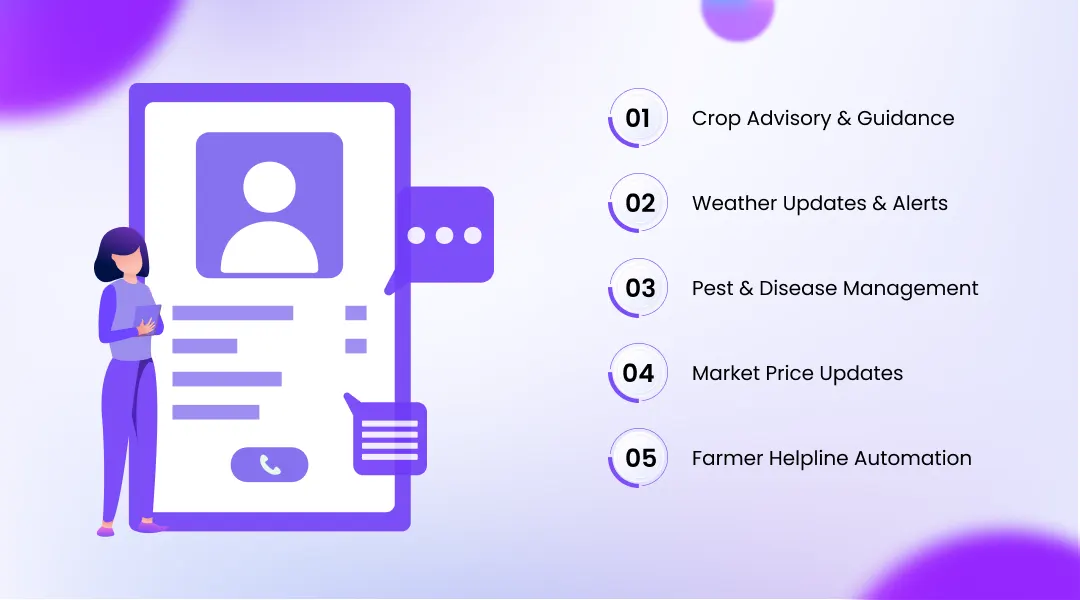
Crop Advisory & Guidance
Farmers constantly need answers:
- When should I sow?
- How much fertilizer should I use?
- Is this soil condition okay?
Instead of waiting days for an expert…
They can ask instantly.
And yes, the system can be trained on region-specific crop data.
That’s where AI-powered agriculture services start becoming practical, not theoretical.
Weather Updates & Alerts
Weather isn’t just information in agriculture.
It’s risk.
Voice agents can:
- Call farmers with alerts before heavy rain
- Provide daily forecasts in local language
- Suggest precautionary actions
And here’s the kicker:
Farmers actually listen to voice alerts.
Push notifications? Ignored.
Pest & Disease Management
This one’s critical.
A delayed response to pest infestation can destroy entire crops.
AI voice agents can:
- Guide farmers based on symptoms
- Suggest treatment options
- Escalate complex cases to human experts
Is it perfect?
No.
But it’s faster than waiting.
And in farming, speed matters.
Market Price Updates
Information asymmetry is a real problem.
Farmers often don’t know:
- Current mandi prices
- Demand trends
- Where to sell
Voice AI can bridge that gap by delivering:
- Daily price updates
- Best nearby markets
- Selling recommendations
That’s not just convenience.
That’s income impact.
Farmer Helpline Automation
Most agricultural helplines fail at scale.
Why?
Because humans can’t handle thousands of calls simultaneously.
AI can.
With AI Voice Agents for Agriculture, helplines can:
- Handle high call volumes
- Provide 24/7 support
- Reduce operational costs
And still escalate complex queries to real experts.
It’s not about replacing humans.
It’s about filtering noise so experts focus on real problems.
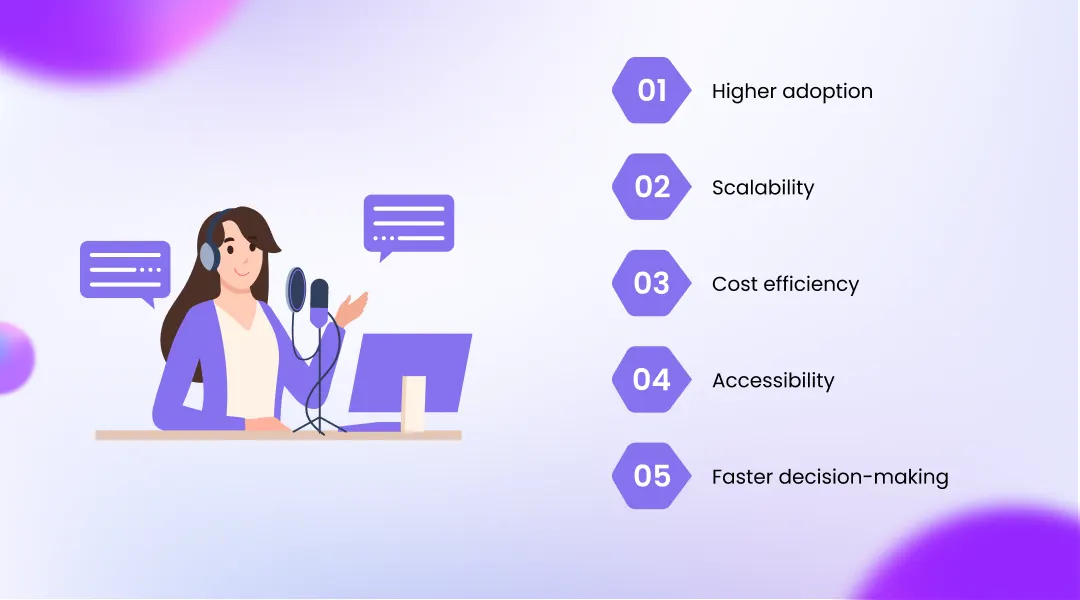
Benefits of AI Voice Agents for Agriculture Services
Let’s cut through the hype and talk real outcomes.
- Higher adoption – because voice feels natural
- Scalability – one system, thousands of farmers
- Cost efficiency – reduced dependency on large support teams
- Accessibility – works even for non-literate users
- Faster decision-making – instant responses
But the biggest benefit?
Trust.
When farmers hear answers in their own language… consistently…
They start relying on it.
That’s when it stops being “technology.”
And becomes infrastructure.
AI Voice Agents for Rural & Regional Language Support
This is where most solutions fail.
India isn’t one language.
It’s hundreds.
And within those—dialects.
I’ve personally seen voice systems fail because they couldn’t understand a farmer from just 50 km away.
So when we talk about smart farming with AI, language isn’t a feature.
It’s the foundation.
Strong systems support:
- Multiple regional languages
- Dialect variations
- Context-aware responses
Without this?
Nothing works.
How Agri Businesses Can Use AI Voice Automation
If you’re running an agri business, here’s the real question:
Are you trying to educate farmers… or actually reach them?
Because those are two very different problems.
Here’s where voice AI fits:
- Input companies can guide product usage
- Agri marketplaces can share price and demand insights
- Dairy and poultry services can manage daily operations
- NGOs can scale advisory programs
And yes, platforms like OnDial are building tailored solutions around this exact gap—practical, human-centric communication.
Not dashboards.
Not vanity metrics.
Actual conversations.
Challenges & Limitations of AI in Agriculture
Let’s not pretend this is perfect.
It’s not.
Some real challenges:
- Accuracy in complex queries
- Dialect understanding
- Data availability for local conditions
- Farmer trust in early stages
- Infrastructure gaps
And here’s something people don’t say enough:
Bad AI is worse than no AI.
If your system gives wrong advice even once…
You lose trust.
And in agriculture, trust is everything.
Future of AI Voice Technology in Farming
Now here’s where things get interesting.
We’re moving toward:
- Hyper-localized advisory systems
- Voice + image-based diagnostics
- Predictive farming insights
- Integration with IoT devices
But I’ll say this carefully.
The future isn’t about “more AI.”
It’s about better conversations.
The systems that win won’t be the smartest.
They’ll be the most understandable.
Conclusion
I’ve spent years watching AgriTech solutions rise and fall.
And if there’s one pattern I trust, it’s this:
Technology succeeds when it respects human behavior.
Not when it tries to change it.
AI voice agents for agriculture work because they meet farmers where they already are.
On the phone.
In their language.
On their terms.
And that’s why this isn’t just another trend.
It’s a shift.