I’ve sat in enough war rooms to recognize panic when I hear it.
Phones ringing. Customers waiting. Agents overwhelmed. Managers pretend everything is “under control.”
That’s usually the moment someone says, “We need more people.” They’re wrong.
What they actually need is a better system for handling Customer Calls—one that doesn’t crack under pressure or call in sick.
That’s where an AI voice assistant enters the conversation. Not as a shiny toy. As infrastructure.
I used to be skeptical. Deeply. Then I watched it work. And fail. And work again—when done right.
Let me show you what I’ve learned.
What Is an AI Voice Assistant and How Does It Work?
An AI voice assistant is a software-based voice system that understands spoken language, responds intelligently, and completes tasks over phone calls.
Not recordings. Not IVR hell.
Real conversations. Powered by conversational AI, speech recognition, and business logic.
Behind the scenes, it:
- Listens to the caller
- Understands intent (not just keywords)
- Responds in natural language
- Connects to systems like CRMs, calendars, or ticketing tools
This is what modern AI Phone Calls look like. And when designed properly, callers often don’t realize they’re speaking to software. That’s not magic. That’s engineering.
Why Are Businesses Rapidly Adopting AI Voice Assistants?
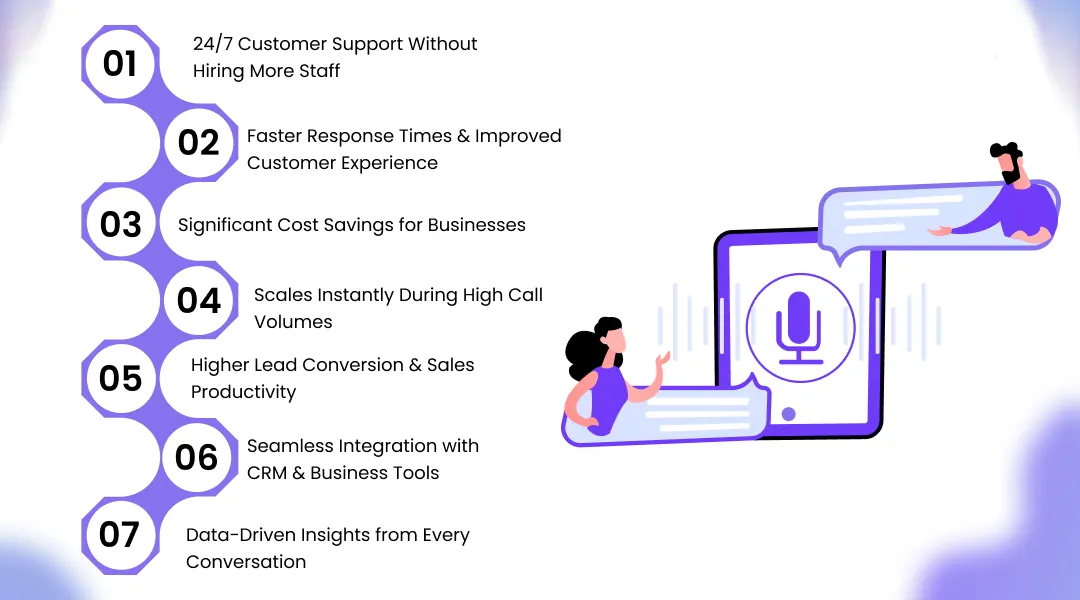
24/7 Customer Support Without Hiring More Staff
Here’s a blunt truth: customers don’t care about your office hours.
They call when something breaks. When they’re anxious. When they’re ready to buy.
An AI voice assistant for customer support doesn’t sleep, doesn’t take breaks, and doesn’t “get back later.”
It answers. Every time.
I’ve seen businesses cut abandoned calls by over 40% simply by letting AI handle after-hours and overflow inquiries. Human agents still matter, but they no longer drown.
Faster Response Times & Improved Customer Experience
Want to lose a customer fast? Make them wait.
AI voice assistants answer immediately. No hold music. No transfers unless necessary.
They:
- Identify intent in seconds
- Route complex issues to humans
- Resolve simple queries instantly
The result? Shorter calls. Happier customers. Less friction.
And yes, customers notice. Even if they don’t consciously realize why the experience felt smoother.
Significant Cost Savings for Businesses
Let’s talk numbers. Quietly.
Hiring, training, and retaining call center staff is expensive. Turnover makes it worse.
AI voice assistant software absorbs repetitive, high-volume interactions:
- FAQs
- Appointment booking
- Order status
- Lead qualification
That frees human agents to handle what humans do best: nuance.
I’ve seen companies reduce support costs while increasing satisfaction scores. That’s rare. And telling.
Scales Instantly During High Call Volumes
Campaign launches. Seasonal spikes. Outages.
Humans scale slowly. Software doesn’t.
An AI voice assistant for call centers can handle 10 calls or 10,000 calls without a meltdown. No panic hiring. No rushed onboarding.
(And yes, I’ve seen what happens when businesses don’t prepare. It’s not pretty.)
Higher Lead Conversion & Sales Productivity
Sales teams miss calls. All the time.
An AI voice assistant for sales calls doesn’t.
It qualifies leads, captures intent, books meetings, and passes warm prospects to reps. Instantly.
This is where AI Call Assistants quietly boost revenue, not by replacing salespeople, but by feeding them better conversations.
Seamless Integration with CRM & Business Tools
A voice system that doesn’t connect to your tools is just noise.
The best AI voice assistants integrate with:
- CRMs
- Helpdesk software
- Calendars
- Analytics platforms
That’s how every call becomes structured data, not guesswork.
Companies like OnDial focus heavily on this layer. It’s why customization matters. And why choosing the Best AI Voice Agent Platform isn’t just about demos—it’s about architecture.
Data-Driven Insights from Every Conversation
Humans forget details. AI doesn’t.
Every call becomes searchable insight:
- Common objections
- Drop-off points
- Customer sentiment
- Agent performance
This is the underrated superpower of AI voice automation for businesses.
You stop guessing. You start knowing.
AI Voice Assistant Use Cases Across Industries
I’ve seen AI voice assistants work across:
- Healthcare (appointment booking, reminders)
- Real estate (lead qualification)
- E-commerce (order support)
- Banking & fintech (verification, FAQs)
- SaaS (support triage)
Different industries. Same principle: remove friction from conversations.
AI Voice Assistant vs Traditional Call Handling
Human agents:
- Empathy
- Judgment
- Creativity
AI voice agents:
- Speed
- Consistency
- Scale
The question isn’t replacement. It’s balance.
The smartest teams design systems where AI handles volume and humans handle value. That’s the real Role of AI Call Agents.
How to Choose the Right AI Voice Assistant for Your Business
Ask hard questions:
- Can it handle real conversations?
- Is it customizable to my workflows?
- Does it integrate cleanly?
- Who builds it and who supports it?
This is where experience matters. A Best AI Development Company doesn’t sell promises. They build partnerships.
If you plan to Hire AI Voice Agents, choose a team that understands both tech and people.
Future of AI Voice Assistants in Customer Communication
Voice isn’t going away. It’s becoming smarter.
Expect:
- More emotional intelligence
- Better multilingual support
- Tighter system integrations
The companies that prepare now won’t scramble later.
Conclusion
I don’t believe in tech for tech’s sake.
I believe in systems that remove stress, create clarity, and let humans focus on meaningful work.
A well-built AI voice assistant does exactly that.
Not loudly. Not dramatically. Just… effectively.
And honestly? That’s the kind of progress I trust.