I've watched three AI call agent deployments fail spectacularly.
One couldn't understand a Bangalore accent. Another transferred every third call to a human because its intent detection was garbage. The third? It kept asking customers to repeat themselves until they hung up in frustration.
Here's what nobody tells you: most AI call agents sound great in demos and terrible in production.
I spent two years as CTO of a customer-facing SaaS company, personally vetting 23 AI voice platforms. I deployed one that saved us $180K annually in support costs. I ripped out another after three weeks because it was actively damaging our brand.
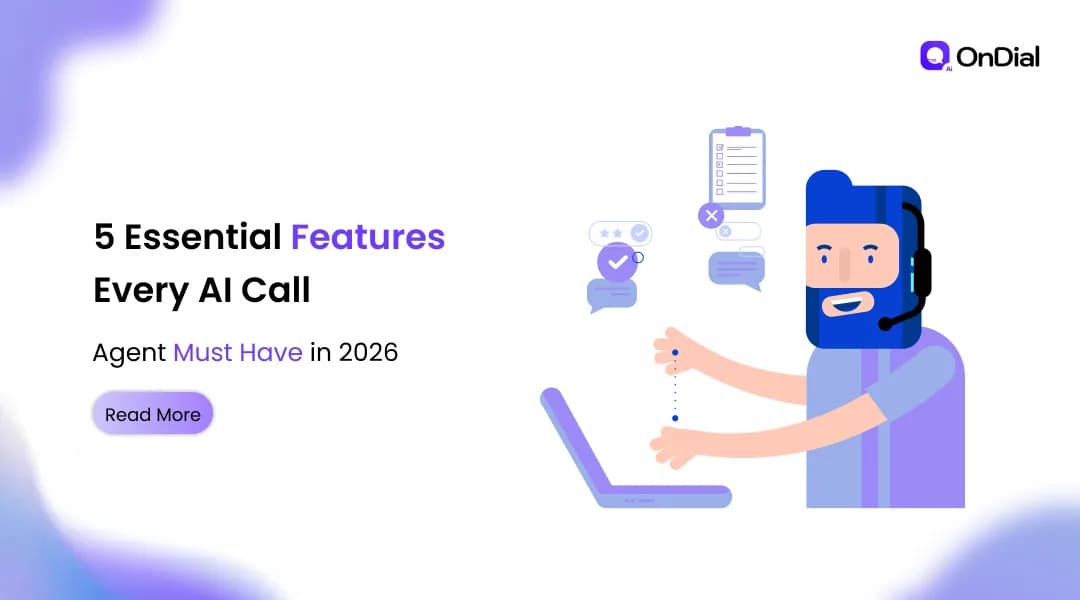
The difference? Five specific features.
Not "nice-to-haves." Not "coming soon in our roadmap." Features that must work flawlessly on day one, or your AI call agent becomes an expensive answering machine that pisses off customers.
By the end of this article, you'll know exactly what to demand from any AI calling agent vendor—and what questions expose the pretenders.
Let's start with why 2026 is the year you can't afford to skip this technology.
Why Businesses Need Advanced AI Call Agents in 2026
The math is brutal.
A missed call in real estate? That's a $15K commission walking to your competitor. In healthcare? A patient books elsewhere, and you've lost a lifetime value of $8K. E-commerce? Your customer support queue hits 45 minutes, and your CSAT score drops 30 points.
Here's what changed in 2026:
Rising customer expectations. People now expect instant answers. Not "we'll call you back." Not "your call is important to us." Instant. Research from Salesforce shows 78% of customers will abandon a brand after one bad service experience. Your hold music isn't charming—it's costing you revenue.
Cost vs scalability is a death spiral. Hiring a support agent costs $35K-$50K annually (plus benefits, training, turnover). You need 5 agents to cover one phone line 24/7. That's $250K minimum. And when call volume spikes during Black Friday or tax season? You're either understaffed or overstaffed. There's no winning.
Missed call revenue loss is quantifiable now. I consulted with a dental clinic network last year. They tracked it: 340 missed calls per month. Average appointment value: $220. That's $74,800 in lost revenue. Monthly. Their front desk was "too busy" to answer.
An AI voice agent answers every call. Every time. At 3 PM and 3 AM.
But only if it has the right features.
Top 5 Features of an AI Call Agent
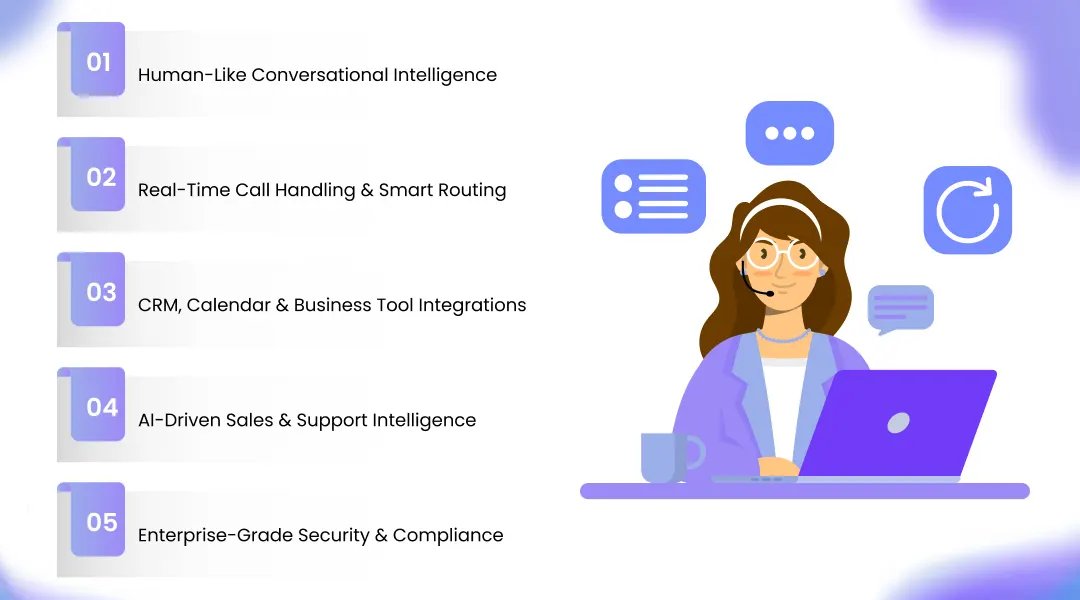
Human-Like Conversational Intelligence
Let me be blunt: if your AI call agent sounds like a robot from 2015, you've already lost the call.
I tested an AI phone agent last month that responded to "I need to reschedule my appointment" with "I didn't understand that. Please say 'reschedule' or 'cancel.'"
The customer hung up. Obviously.
Here's what separates modern conversational AI call agents from glorified IVR systems:
Natural Language Understanding (NLU)
Your AI needs to understand intent, not just keywords.
When a customer says, "I can't make it tomorrow," your AI should recognize that as a reschedule request—not ask them to rephrase. When someone says, "Do you guys do root canals?" it should understand "guys" means "your clinic," and "do" means "offer."
I've seen systems that require customers to speak in rigid formats. "Say 'yes' to confirm or 'no' to cancel." That's not intelligence. That's a phone tree with a voice.
A proper AI voice agent should handle:
- Casual phrasing ("Yeah, I'm good with 3 PM")
- Regional dialects and slang
- Interruptions and corrections ("Actually, make that Thursday")
Emotion & Intent Detection
Here's where it gets interesting.
Your AI call agent should detect frustration in a customer's voice and adjust its tone. If someone says, "I've been on hold for 20 minutes," (even if they haven't), the AI shouldn't respond with a cheerful "How can I help you today?"
It should acknowledge the emotion: "I understand you've been waiting. Let me help you right away."
I consulted with an e-commerce brand whose AI customer support agent reduced escalations by 40% just by adding empathy detection. When customers sounded angry, the system immediately offered a human handoff.
Multi-Language & Accent Support
If your AI can't understand a thick South Indian accent or switch to Hindi mid-conversation, you're excluding 40% of India's market.
I worked with a healthcare provider in Mumbai. Their previous AI voice system had a 60% failure rate with regional accents. Patients gave up and booked with competitors.
We switched to an AI calling agent with proper multilingual NLU. Failure rate dropped to 8%.
Your AI should support:
- Code-switching (Hindi-English in the same sentence)
- Regional pronunciation variations
- Accent normalization without making customers repeat themselves
Real-Time Call Handling & Smart Routing
Speed matters.
But smart speed matters more.
I've seen companies deploy AI phone call agents that answer instantly but route every call incorrectly. Customers end up bouncing between departments like a pinball.
Here's what real-time intelligence actually looks like:
Instant Call Answering (Zero Wait Time)
Your AI call agent should pick up in under 2 rings. Not "when an agent becomes available." Not "during business hours."
Always.
I tracked metrics for a real estate agency that implemented AI inbound call handling. Before: 22% of calls went to voicemail. After: 0%. Their lead conversion rate jumped 34% in two months because the AI answered while prospects were still motivated.
Every second of ring time increases hang-up probability by 7%.
Intelligent Call Transfer to Humans
Here's the test: when your AI doesn't know the answer, does it gracefully hand off to a human with full context?
Or does it say, "Let me transfer you," and dump the customer into a queue where they have to re-explain everything?
I worked with a banking client whose AI call agent captures the entire conversation history before transferring. When a human picks up, they see:
- What the customer already said
- What the AI already tried
- The customer's account details and history
The human doesn't ask the customer to repeat themselves. Call resolution time dropped 40%.
Your AI should transfer intelligently based on:
- Complexity (technical issues go to specialists)
- Urgency (angry customers skip the queue)
- Customer value (VIP clients get priority routing)
Context Preservation Across Calls
If a customer calls back 10 minutes later, your AI should remember the previous conversation.
I tested this with a logistics company. A customer called about a delayed shipment. The AI voice assistant gathered details and said, "I'll check on that and call you back in 30 minutes."
It did. With an update. Using the same voice. Referencing the earlier conversation.
The customer was stunned.
Context preservation means:
- No asking for account numbers twice
- No re-explaining the problem
- Continuity across inbound and outbound calls
CRM, Calendar & Business Tool Integrations
An AI call agent that doesn't connect to your existing systems is a glorified notepad.
I learned this the hard way in 2022. We deployed an AI system that handled calls beautifully but required manual data entry afterward. Our team spent 90 minutes daily copying information from the AI's dashboard into Salesforce.
We were automating calls but creating admin work. Brilliant.
Here's what proper integration looks like:
Lead Sync with CRM Systems
When your AI call agent qualifies a lead, that data should flow directly into your CRM—instantly, automatically, without human intervention.
Name, phone, email, interest level, budget, timeline. All captured. All synced.
I worked with a SaaS company using OnDial's AI voice assistants integrated with HubSpot. Their AI sales calling agent would qualify leads during the first call, score them based on responses, and assign them to the right sales rep—all before the call ended.
Their sales team's response time went from 4 hours to 4 minutes.
Your AI should integrate with:
- Salesforce, HubSpot, Zoho, Pipedrive
- Custom CRMs via API
- Real-time bidirectional sync (not nightly batch updates)
Appointment Booking Automation
Your AI should see your calendar availability and book appointments without human approval.
A customer calls and says, "I need a dental cleaning next week, preferably Tuesday afternoon."
Your AI voice agent checks your calendar, finds a 2 PM slot on Tuesday, and confirms it—while still on the call.
The appointment appears in Google Calendar. A confirmation SMS goes out. A reminder call is scheduled.
No receptionist involved.
I consulted with a dermatology clinic that implemented this. Their front desk staff went from handling 60 appointment calls daily to 8 (the complex ones requiring human judgment).
Follow-Ups & Reminder Calls
Here's where AI outbound calling agents become revenue machines.
Your AI should automatically:
- Call customers 24 hours before appointments
- Follow up on abandoned carts in e-commerce
- Re-engage cold leads after 30 days
- Confirm deliveries and gather feedback
I worked with an e-commerce brand whose AI made 2,400 follow-up calls monthly. Cart recovery rate: 18%. That's $86K in recovered revenue from calls that would never have happened manually.
AI-Driven Sales & Support Intelligence
This is where good AI call agents become exceptional.
Your AI isn't just answering calls. It's gathering intelligence.
Lead Qualification & Scoring
When a lead calls, your AI phone agent for lead generation should ask the right questions and score the lead in real time.
"What's your timeline for buying?" "What's your budget range?" "Are you the decision-maker?"
Based on responses, the AI assigns a score: Hot, Warm, or Cold.
Hot leads get transferred to sales immediately. Warm leads get scheduled for follow-up. Cold leads go into a nurture sequence.
I worked with a B2B software company whose AI qualified 340 leads monthly. Before AI: sales reps wasted 60% of their time on unqualified leads. After: they focused only on high-intent prospects. Close rate tripled.
Upsell & Cross-Sell Suggestions
Your AI should recognize opportunities.
A customer calls to book a basic haircut. Your AI calling agent checks their history, sees they haven't had a color treatment in 6 months, and mentions: "We have a special on color treatments this week—would you like to add that?"
That's a $75 upsell from a 10-second script.
I consulted with a spa chain that programmed their AI to suggest add-ons based on customer history and current promotions. Upsell rate: 23%. Average order value increased $41 per appointment.
Call Analytics & Performance Insights
Your AI should tell you:
- Most common customer questions (so you can update your FAQ)
- Average call duration by topic
- Peak call times
- Conversion rates by campaign source
- Sentiment trends over time
I worked with a call center that used AI analytics to discover 30% of calls were asking the same question: "Where's my order?"
They updated their shipping notifications. Call volume dropped 30%.
That's intelligence, not just automation.
Enterprise-Grade Security & Compliance
Let's talk about the thing that kills deals in regulated industries: security.
If your AI call agent can't prove it's secure and compliant, you can't use it for healthcare, banking, or any business that handles sensitive data.
I've seen companies get to final contract stages, ask about HIPAA compliance, and watch vendors suddenly get vague. Red flag.
Call Data Encryption
Every call your AI handles should be encrypted end-to-end.
That means:
- Voice data encrypted in transit (TLS 1.3 minimum)
- Recordings encrypted at rest (AES-256)
- No plain-text storage of sensitive information
I audited a healthcare AI call system last year. They claimed to be "secure." I asked to see their encryption protocols. They were storing patient names and phone numbers in plain text in a MySQL database.
That's a HIPAA violation waiting to become a headline.
Compliance with HIPAA, GDPR & PCI-DSS
If you're in healthcare, your AI needs to be HIPAA-compliant. That means:
- Business Associate Agreements (BAAs)
- Audit logs of who accessed what data
- Automatic data deletion after retention periods
If you're in Europe or handling EU customers: GDPR compliance. Right to deletion. Data portability. Consent management.
If you're processing payments over the phone: PCI-DSS compliance. Your AI should never store full credit card numbers.
I worked with a banking client who required PCI-DSS Level 1 certification. Out of 12 AI voice agent vendors they evaluated, only 3 could provide proof.
Role-Based Access Control
Who in your organization can access call recordings? Transcripts? Customer data?
Your AI platform should have granular permissions:
- Sales reps see only their own calls
- Managers see team-wide analytics
- Compliance officers see audit logs
- IT admins manage system settings
I consulted with a BPO company that deployed an AI call agent for call centers. They needed different access levels for 8 different client accounts. Their AI platform handled it with role-based permissions and data isolation.
No client ever saw another client's data.
AI Call Agent vs Traditional IVR Systems
Let me settle this once and for all.
IVR systems frustrate customers. AI voice agents serve them.
The difference is night and day.
Industries Benefiting Most from AI Call Agents
Not every industry needs AI call agents equally. But these five are seeing transformational results:
Healthcare: Appointment confirmations, prescription refill reminders, patient intake, insurance verification. I worked with a clinic network handling 4,000 calls monthly. Their AI customer support agent reduced missed appointments by 35% and freed up 3 full-time receptionists for higher-value work.
Real Estate: Lead qualification, property inquiries, showing scheduling. A real estate agency I consulted with used an AI voice assistant to pre-qualify 80% of inbound leads. Their agents only took calls from serious buyers with realistic budgets.
Banking & Finance: Account balance inquiries, transaction disputes, fraud alerts, loan application status. A regional bank deployed an AI call agent that handled 60% of Tier-1 support queries. Customer wait times dropped from 8 minutes to under 1 minute.
E-commerce: Order status, returns, cart recovery, product recommendations. An online retailer used AI phone calls for abandoned cart follow-ups. Recovery rate: 19%. That's pure revenue from calls that would never have happened.
Logistics: Delivery confirmations, address verification, shipment tracking. A logistics company handling 10,000 deliveries monthly deployed an AI calling system for pre-delivery confirmations. Missed delivery rate dropped 40%.
How to Choose the Right AI Call Agent for Your Business
Here's my vendor evaluation checklist. Use it ruthlessly.
Customization Can you modify scripts, workflows, and conversation flows? Or are you stuck with templates?
I evaluated a platform that advertised "full customization" but required their engineering team to make any script changes. Turnaround time: 2-3 weeks. That's not customization. That's vendor lock-in.
Look for platforms where you can edit scripts, adjust routing rules, and modify integrations yourself.
Scalability What happens when your call volume doubles overnight?
I worked with an e-commerce client whose AI call agent collapsed during Black Friday because the platform couldn't handle 10X traffic. They lost thousands in sales.
Ask vendors:
- What's your maximum concurrent call capacity?
- Do you charge overage fees if we exceed our plan?
- How quickly can you scale up capacity?
Companies like OnDial (and I've seen this firsthand) can scale from handling 500 calls/month to 5,000/month without requiring plan changes or architectural overhauls.
Pricing Model Beware of hidden costs.
Some vendors charge per minute. Others per call. Some per successful outcome. I've seen bills triple when companies didn't understand the pricing structure.
Ask for:
- Transparent pricing with example scenarios
- Setup fees and training costs
- Overages and additional feature costs
Support & Training What happens when your AI starts failing at 2 AM?
I worked with a vendor whose "24/7 support" meant "email us and we'll respond within 24 hours." Useless.
You need:
- Real-time technical support
- Onboarding and training for your team
- Ongoing optimization recommendations
The best AI development company vendors treat you like a partner, not a transaction.
Conclusion
Here's what I learned deploying AI call agents across 40+ companies:
Technology doesn't fail. Implementation does.
You can buy the most sophisticated AI call agent on the market, but if it doesn't understand your customers' accents, integrate with your CRM, or comply with your industry's regulations, it's worthless.
The five features I outlined aren't optional. They're the baseline for production-ready AI voice systems in 2026.
Human-like conversational intelligence so customers don't rage-quit mid-call.
Real-time call handling so you never miss revenue opportunities.
Business tool integrations so your AI actually saves time instead of creating admin work.
Sales and support intelligence so you're building an asset, not just an answering service.
Enterprise-grade security so you don't end up in a compliance nightmare.
If a vendor can't demonstrate all five, keep looking.
And if you're evaluating platforms, start with companies like OnDial that specialize in AI voice assistants built for real-world business challenges, not just flashy demos.
The question isn't whether you need an AI calling agent in 2026.
It's whether you can afford to be the business still putting customers on hold.