I’ve sat in too many boardrooms where someone says, “Let’s add AI voice agents and fix customer experience.” That sentence usually lands with a thud.
Because customer experience doesn’t break due to lack of technology. It breaks due to friction. Delay. Repetition. Humans forced to act like scripts. And systems that don’t talk to each other.
I’ve also watched AI voice agents fail spectacularly. Flat voices. Missed intent. Customers shouting “agent” into the void. So no—this isn’t a cheerleading piece.
This is a grounded look at what the best voice agents are actually doing in 2026 to change how customers experience support, sales, and service. Not theory. Not hype. Reality.
What Are AI Voice Agents?
AI voice agents are not IVR menus with better marketing.
They’re systems that understand spoken language, interpret intent, respond conversationally, and complete tasks across Customer Calls, support workflows, and sales pipelines.
Early versions followed scripts. Modern voice agents reason in context.
That shift matters.
How Voice Agents Work Using AI & NLP
Under the hood, strong voice agents combine:
- Speech recognition
- Natural language understanding
- Dialogue management
- Integration with CRMs, ticketing systems, and backend tools
But the real difference isn’t the stack. It’s how well the system remembers what was said five seconds ago—and what it should do next.
That’s where most implementations fall apart.
Why Businesses Are Switching to Voice Agents in 2026
This didn’t happen overnight.
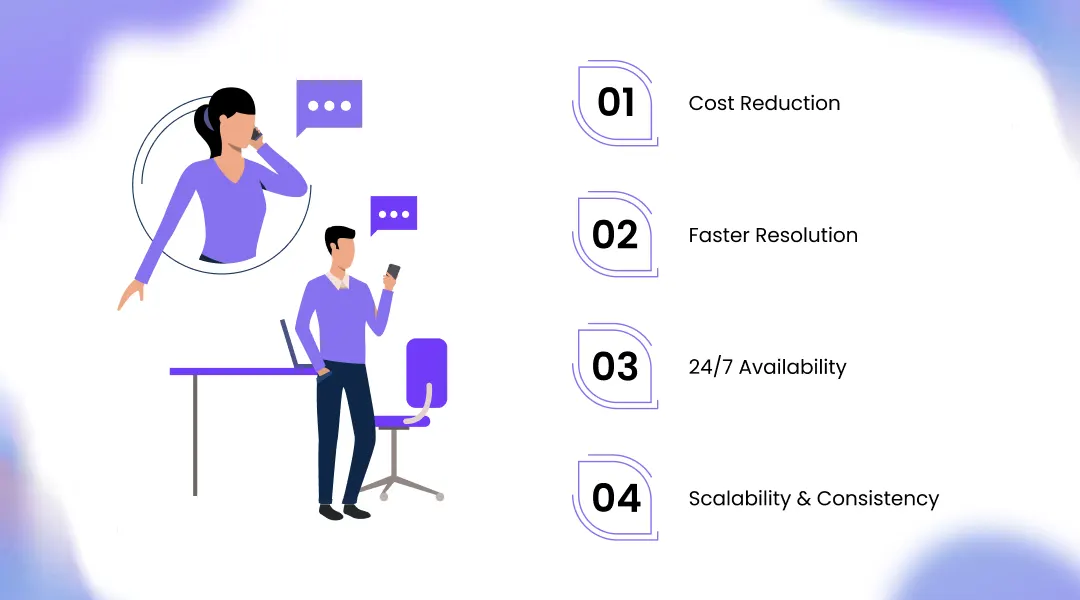
Cost Reduction
Voice agents don’t replace teams. They absorb volume.
Password resets. Order status. Appointment reminders. Payment confirmations. The calls humans never wanted in the first place.
Faster Resolution
Customers don’t want empathy first. They want answers first.
The best AI voice agents resolve issues in one interaction, without transfers or hold music.
24/7 Availability
Your customers don’t run on office hours. Your support shouldn’t either.
Scalability & Consistency
Seasonal spikes don’t scare voice agents. Product launches don’t exhaust them. And they don’t forget policy updates halfway through a shift.
The Impact of Conversational Voice Agents on Customer Satisfaction
This is where the gap between “AI demo” and “production system” becomes painfully obvious.
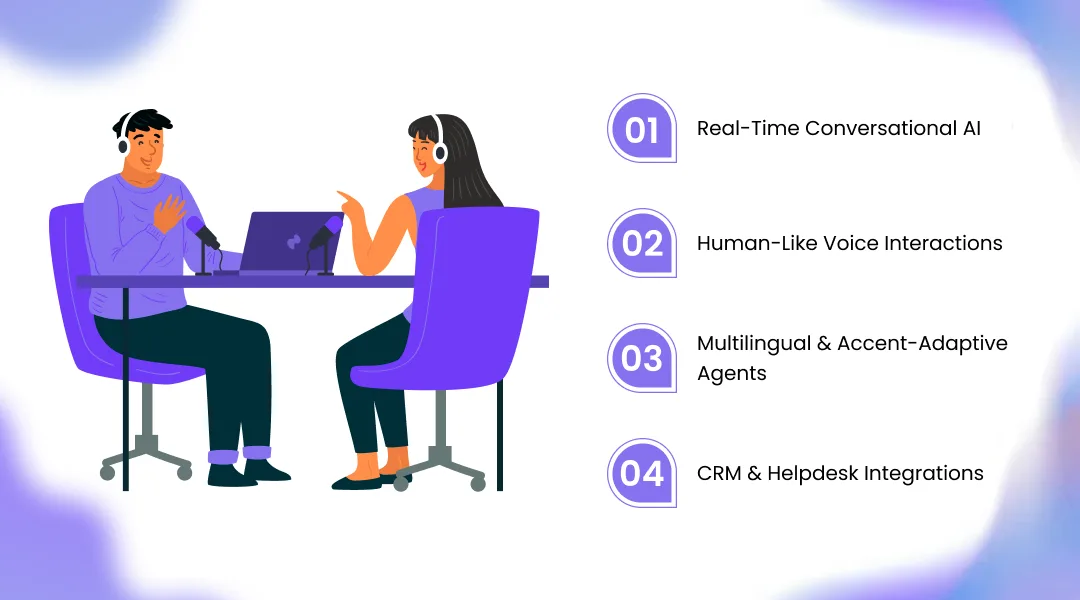
Real-Time Conversational AI
Latency kills trust.
Top-tier voice AI responds fast enough that users don’t notice the machine. That’s the bar now.
Human-Like Voice Interactions
Not emotional manipulation. Natural pacing. Clear pronunciation. Smart pauses.
Small details. Massive impact.
Multilingual & Accent-Adaptive Agents
English-only is a liability.
The best multilingual voice agents adapt to accents, regional phrasing, and local context, especially in global BPO environments.
CRM & Helpdesk Integrations
If your voice agent can’t read or update tickets, it’s just noise.
Strong platforms integrate directly with CRMs, helpdesks, and analytics tools—turning conversations into action.
Use Cases of AI Voice Agents Across Industries
Call Centers & BPO
Inbound triage. Outbound follow-ups. Compliance-safe automation at scale.
This is where AI call center automation delivers immediate ROI.
E-commerce & Retail
Order tracking. Returns. Payment issues. Handled instantly—without chat queues.
Healthcare & Telemedicine
Appointment scheduling. Prescription reminders. Privacy-sensitive. Accuracy-focused. Non-negotiable.
Banking, FinTech & Insurance
KYC calls. Claims status. Policy explanations. Voice agents reduce wait times without risking trust.
SaaS & Tech Support
First-line troubleshooting that actually understands context—not keywords.
Voice Agents vs Traditional Customer Support
Let’s be blunt.
Cost Comparison
Voice agents reduce cost per interaction. Humans handle edge cases and emotional moments.
Both matter.
Performance Metrics
Voice agents excel at:
- Speed
- Accuracy for known issues
- Consistency
Humans still win on nuance.
Customer Satisfaction Impact
When deployed correctly, voice agents for customer experience raise CSAT, not lower it.
When deployed badly? You already know the answer.
Key Features to Look for in the Best Voice Agents
If you’re evaluating platforms, stop looking at demos. Look for this:
Natural Language Understanding
Can it handle interruptions? Mid-sentence changes? Real humans don’t speak in bullet points.
Context Awareness
Does it remember previous interactions? Or does every call feel like déjà vu?
Omnichannel Support
Voice doesn’t exist alone. Your Voice Assistant should align with chat, email, and CRM history.
Analytics & Call Insights
If you can’t measure outcomes, you can’t improve them.
How Voice Agents Improve Customer Experience Metrics
This is where skepticism usually fades.
Reduced Wait Times
No queues. No transfers. No dead air.
Higher CSAT & NPS
Clarity beats charm. Speed beats small talk.
First Call Resolution (FCR)
When voice agents have access to systems—not scripts—FCR rises.
Challenges & Limitations of Voice AI
Let’s not pretend this is magic.
Accuracy Concerns
Solved through continuous training—not one-time setup.
Data Privacy
Enterprise-grade security isn’t optional. Especially in finance and healthcare.
AI Training & Optimization
Voice AI improves only if someone owns it. Neglect kills performance.
Future of Voice Agents Beyond 2026
This is where things get interesting.
Emotional AI
Not fake empathy. Situational awareness.
Hyper-Personalized Conversations
Every call informed by history, behavior, and preference.
AI + Human Hybrid CX Models
Voice agents handle volume. Humans handle moments that matter.
That’s the future I trust.
Conclusion
The best voice agents in 2026 don’t try to sound human. They try to be useful.
They respect time. They reduce friction. They support humans instead of replacing them.
If you’re working with a Best AI Development Company or planning to Hire AI Voice Agents, don’t ask for promises.
Ask for proof. Ask for outcomes. Ask for honesty.
That’s how real customer experience is built.