I’ll start with an uncomfortable truth.
Most businesses don’t need better communication. They need fewer broken conversations.
I’ve worked with founders who proudly installed AI voice systems, only to quietly disable them three months later. Not because the tech didn’t work. But because it didn’t fit how real customers talk, interrupt, hesitate, or change their minds mid-sentence.
I’m a Senior AI Consultant at OnDial, and for over a decade I’ve helped businesses replace fragile call workflows with voice agents that can actually hold their ground in live conversations. Some of those deployments saved teams millions. Others taught expensive lessons.
This article exists so you don’t repeat the second category.
What Are AI Voice Agents?
Let’s strip away the hype.
AI voice agents are software-based callers that can listen, understand intent, respond naturally, and take action during phone calls, without human involvement.
They are not:
- Pre-recorded voice menus
- Scripted IVR flows
- “Press 1 for sales” nonsense
A real AI voice agent for business communication understands what the caller wants, even when the caller doesn’t explain it cleanly.
And no, customers don’t hate them by default. They hate bad ones.
How Voice AI Actually Works in Business
Behind every competent voice agent is a stack that looks roughly like this:
Speech → Meaning → Decision → Action → Response
The important part isn’t the technology itself. It’s how tightly these layers are connected to your business systems.
If your voice agent can talk but can’t do, it’s useless.
Why Smart Voice Communication Is No Longer Optional
Let me ask you something uncomfortable.
When was the last time you enjoyed calling a business?
Exactly.
Customer Expectations Have Quietly Shifted
Customers now expect:
- Immediate answers
- Zero repetition
- Conversations that remember context
They don’t announce these expectations. They just leave when you don’t meet them.
Traditional Call Systems Are Failing Quietly
Most call centers don’t collapse dramatically. They erode.
Missed calls. Rushed agents. Burnout. Inconsistent answers.
Voice AI didn’t appear because it was trendy. It appeared because human-only systems hit a ceiling.
What Separates the Best Voice Agents from the Rest
Here’s where most comparison articles fail.
They list features. I look at failure points.
Natural Language Understanding That Tolerates Mess
Real callers:
- Interrupt themselves
- Use incomplete sentences
- Change intent mid-call
If your voice agent can’t handle that, it will fail in week one.
Real-Time Response Without Awkward Pauses
Silence breaks trust on a phone call faster than anything else.
Latency isn’t a technical metric. It’s an emotional one.
Language, Accent, and Cultural Awareness
If your customers speak Hinglish, regional English, or mixed-language phrases, your voice agent must understand that reality.
Anything else is academic.
Deep Integration with Business Systems
The best AI voice agent solutions don’t feel like add-ons.
They:
- Read CRM history
- Update tickets
- Trigger workflows
- Book calendars
A talking system that can’t act is just noise.
The Role of AI Voice Agents in Intelligent Business Communication
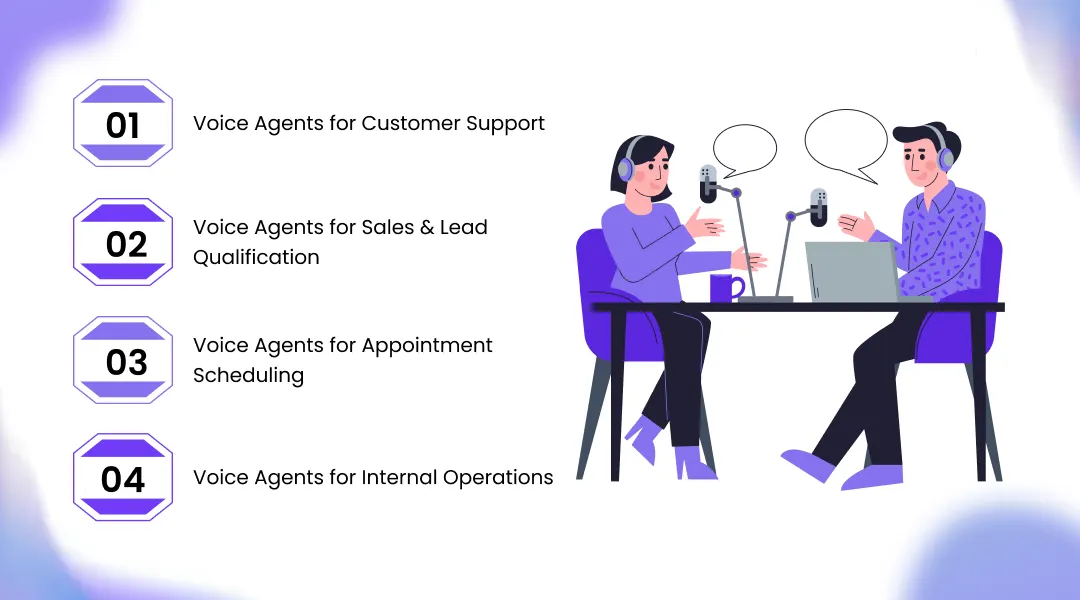
Instead of ranking vendors, let’s talk outcomes.
Voice Agents for Customer Support
These handle:
- Order tracking
- Policy questions
- Issue logging
- Status updates
They work best when calls are frequent, predictable, and emotionally neutral.
And yes, customers often prefer them to rushed humans.
Voice Agents for Sales & Lead Qualification
This is where skepticism turns into belief.
Voice agents can:
- Call leads instantly
- Ask qualifying questions
- Filter serious buyers
- Book meetings automatically
Speed wins deals. Voice agents remove hesitation.
Voice Agents for Appointment Scheduling
Healthcare. Real estate. Professional services.
Missed calls here equal lost revenue.
Voice agents don’t miss calls. Ever.
Voice Agents for Internal Operations
Internal communication is the hidden goldmine.
Leave approvals. Shift confirmations. IT tickets.
Low excitement. Massive time savings.
How AI Voice Agents Improve Customer Experience
Let’s be precise.
Voice agents don’t improve experience by being “AI.” They improve it by removing friction.
Faster Resolution
Customers want answers, not empathy scripts.
Always-On Availability
Problems don’t respect office hours.
Neither should your communication layer.
Context-Aware Conversations
When a voice agent remembers past interactions, the tone changes instantly.
Customers feel recognized, not processed.
Real Business Use Cases I’ve Seen Work
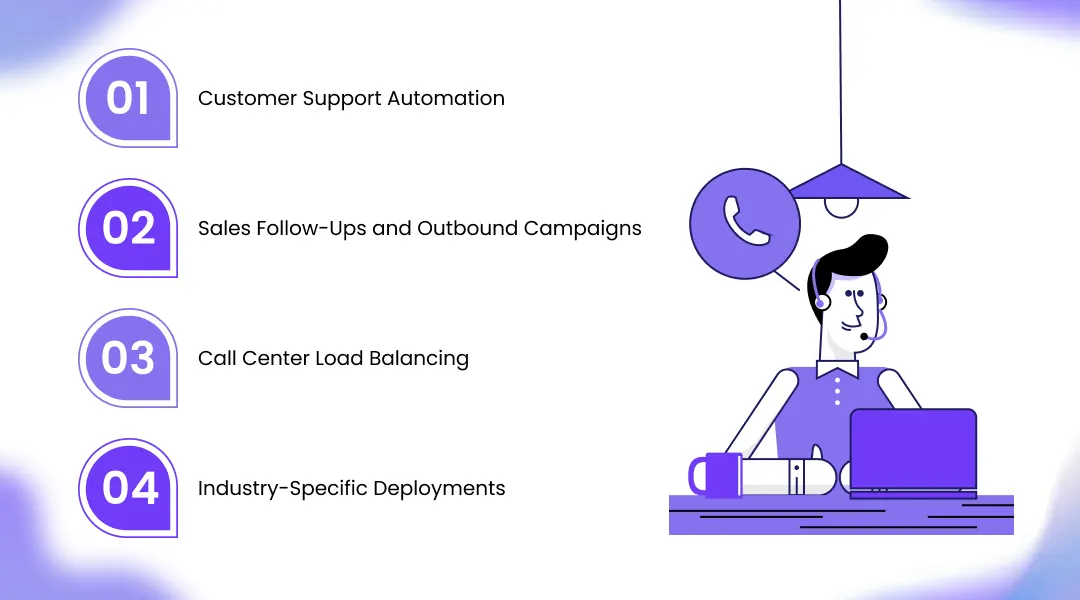
This isn’t theory.
Customer Support Automation
Handled correctly, this reduces call volume by 40–60%.
Not overnight. But sustainably.
Sales Follow-Ups and Outbound Campaigns
Consistent follow-ups without human fatigue.
Sales teams focus on closing, not chasing.
Call Center Load Balancing
AI handles first contact. Humans handle exceptions.
That hybrid model outperforms both extremes.
Industry-Specific Deployments
- Healthcare: reminders and confirmations
- Banking: verification and alerts
- E-commerce: delivery and returns
Voice is still the most trusted channel in high-stakes moments.
How to Choose the Right Voice Agent for Your Business
This is where deals are won or regretted.
Fit Beats Features
A complex system for a simple workflow is a liability.
Start with your call patterns, not the demo.
Integration Is the Real Test
If integration feels “phase two,” walk away.
Scalability and Compliance
Voice data is sensitive.
Security failures don’t announce themselves politely.
AI Voice Agents vs Traditional Call Systems
Let’s stop pretending this is a fair fight.
Cost Behavior
Traditional systems scale linearly. Voice agents flatten costs over time.
Operational Reliability
No sick days. No training cycles. No turnover.
Customer Satisfaction
Customers don’t care who answers.
They care how fast and how accurately.
Conclusion
AI voice agents succeed or fail based on one thing: how well they handle real conversations, not perfect scripts. When built and implemented correctly, they reduce wait times, handle high call volumes, and keep customer communication consistent without exhausting human teams.
The best voice agents don’t try to sound impressive. They focus on being reliable, responsive, and clear—especially when call volumes grow and expectations rise. For businesses that want communication to scale without losing control, smart voice agents are no longer optional. They’re foundational.