I’m going to say something most ecommerce founders don’t want to hear.
Your RTO problem isn’t a logistics problem.
It’s a confirmation problem.
Over the last eight years, I’ve worked with Indian D2C brands doing 50 orders a day… and others doing 25,000. The pattern is always the same. When COD is more than 60% of orders, chaos begins. Fake orders. Unreachable customers. Address errors. Return shipments eating margins alive.
And then what do founders do?
They hire more callers.
More people. More spreadsheets. More stress.
But the math doesn’t lie. Humans don’t scale predictably. Systems do.
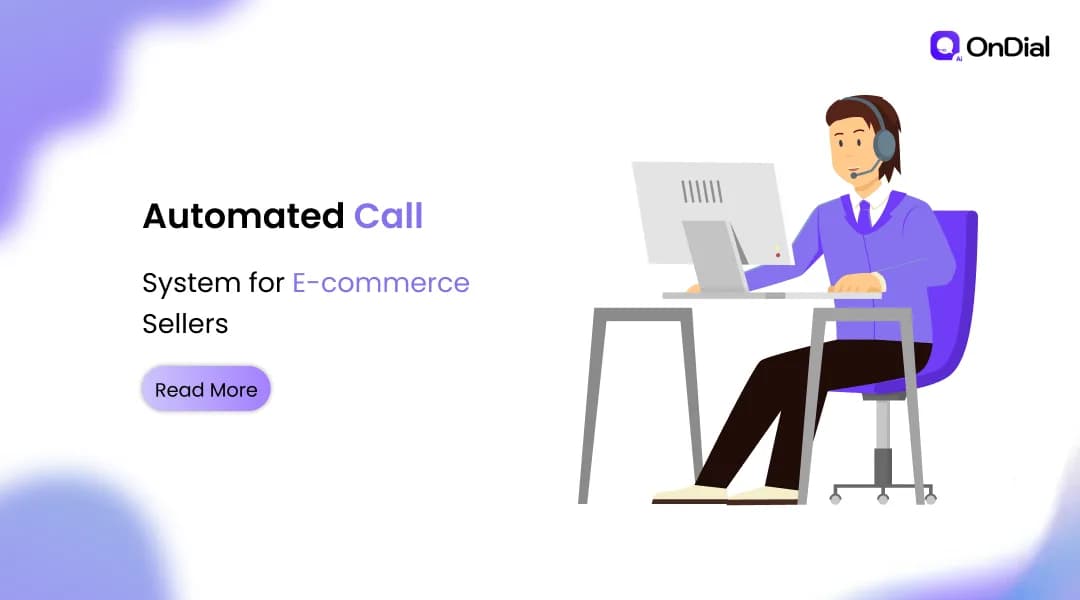
That’s where an automated call system for e-commerce sellers changes the equation.
Not as a shiny AI experiment.
But as operational discipline.
Let’s break it down properly.
What Is an Automated Call System for E-commerce?
At its core, an automated call system for online stores is a software-driven system that places outbound calls to customers immediately after an order is placed.
Its primary job?
Order confirmation.
Especially for COD.
Now here’s where most people get confused.
IVR vs AI Voice Bot – What’s the Difference?
A traditional IVR call system for ecommerce works like this:
“Press 1 to confirm your order. Press 2 to cancel.”
It’s structured. Robotic. Limited.
An AI-powered system - often built by teams like OnDial, an India-based conversational AI company - goes further. Instead of rigid menu trees, it uses conversational intelligence similar to modern AI Voice Assistants.
It can:
- Understand natural speech
- Handle objections
- Repeat address details
- Detect hesitation
- Escalate to human agents when needed
In simple terms?
IVR follows scripts. AI listens.
And in Tier 2 and Tier 3 markets, that difference matters.
Why E-commerce Sellers Need Automated Order Confirmation Calls
Let’s talk about the real villain.
COD fraud.
I once audited a fashion D2C brand losing ₹18 lakhs per month purely due to fake COD orders. Not logistics inefficiency. Not bad packaging.
Fake orders.
Some customers place orders casually. Some enter wrong numbers. Some never intended to accept delivery.
If you ship without confirming, you gamble.
An ecommerce order verification call system eliminates that gamble.
Here’s what typically happens without automation:
- Orders pile up.
- Calling team lags behind.
- Dispatch gets delayed.
- Customer loses excitement.
- Cancellation probability increases.
And if your brand operates on marketplaces like Amazon or Flipkart?
Late dispatch impacts ratings.
An automated voice call for order confirmation ensures every COD order is verified within minutes.
Not hours.
Minutes.
Speed builds certainty.
How Automated Call Systems Work for Online Stores
Let’s demystify it.
Step 1: Order Placed
Customer places an order on Shopify or WooCommerce.
Step 2: API Integration
Your store connects to an AI call system for ecommerce via API. The moment an order is placed, data is pushed instantly.
Step 3: Auto Call Trigger
The system triggers order confirmation automated calls within 30–120 seconds.
(Yes, speed matters. Attention span drops fast.)
Step 4: Customer Input Capture
The system:
- Asks for confirmation
- Verifies address
- Detects cancellation intent
- Updates CRM automatically
No manual spreadsheet.
No copy-paste errors.
This is where modern AI Call Assistants outperform traditional systems. They don’t just record button presses; they interpret intent.
And if needed?
They transfer to human teams.
That’s the true Role of AI Call Agents - not replacement. Amplification.
Key Benefits of Using an Automated Call System
Let’s move from theory to numbers.
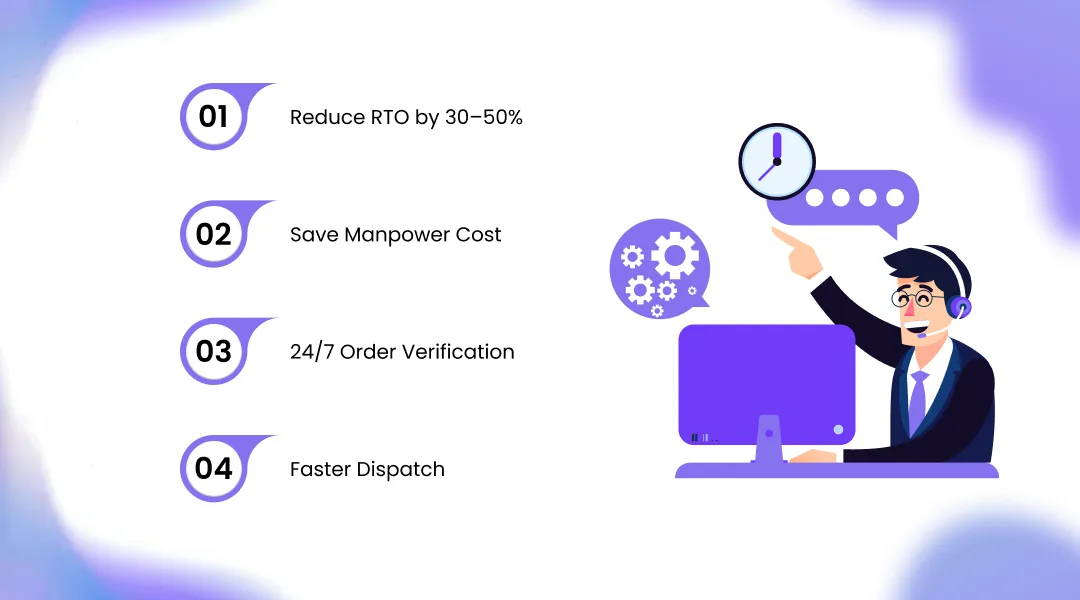
Reduce RTO by 30–50%
I’ve seen brands drop RTO from 38% to 19% within 60 days after implementing a COD order confirmation call system.
Why?
Because fake and unreachable orders get filtered early.
Save Manpower Cost
Let’s do simple math.
5 callers × ₹15,000 salary = ₹75,000/month.
And they still can’t call every order instantly.
An automated system handles thousands of Customer Calls daily without fatigue.
24/7 Order Verification
Humans work shifts.
AI doesn’t.
Orders placed at 11:47 PM? Confirmed immediately.
Faster Dispatch
Faster confirmation = same-day dispatch.
Same-day dispatch = better NPS.
See the domino effect?
Features to Look for in an Ecommerce Call Automation System
Not all systems are equal.
Here’s what I insist on when brands ask me which platform to choose.
Multi-Language Support
India is diverse. Hindi, Gujarati, Tamil, Bengali — your system must speak customer language naturally.
AI Voice Bot (Not Just IVR)
Look for real conversational AI. This is where working with a Best AI Development Company makes a difference.
CRM Integration
Automatic tagging. Confirmation status. Cancellation reasons.
No manual intervention.
Shopify & WooCommerce Integration
Your automated call system for online stores must plug in instantly.
WhatsApp Fallback
If a customer misses a call, automated WhatsApp confirmation link should trigger.
Redundancy reduces loss.
When evaluating vendors, ask them directly:
Are you just selling software? Or are you offering partnership?
Companies like OnDial focus on tailored systems rather than generic tools — and that distinction becomes visible after 90 days of usage.
Automated Call System vs Manual Calling: Cost Comparison
Let’s be brutally practical.
Manpower Cost
10,000 orders/month.
Even if each call takes 90 seconds, you need multiple full-time agents.
Salary + training + attrition cost.
Time Efficiency
Humans:
- Miss calls
- Get tired
- Take breaks
AI:
- Calls instantly
- Works continuously
- Handles volume spikes during sales
Scalability
During festive sales, order volume doubles.
Do you double hiring overnight?
Or does your AI Phone Calls system scale automatically?
(Answer that honestly.)
When brands decide to Hire AI Voice Agents, they’re not replacing people. They’re removing friction.
How to Reduce RTO in Ecommerce Using Call Automation
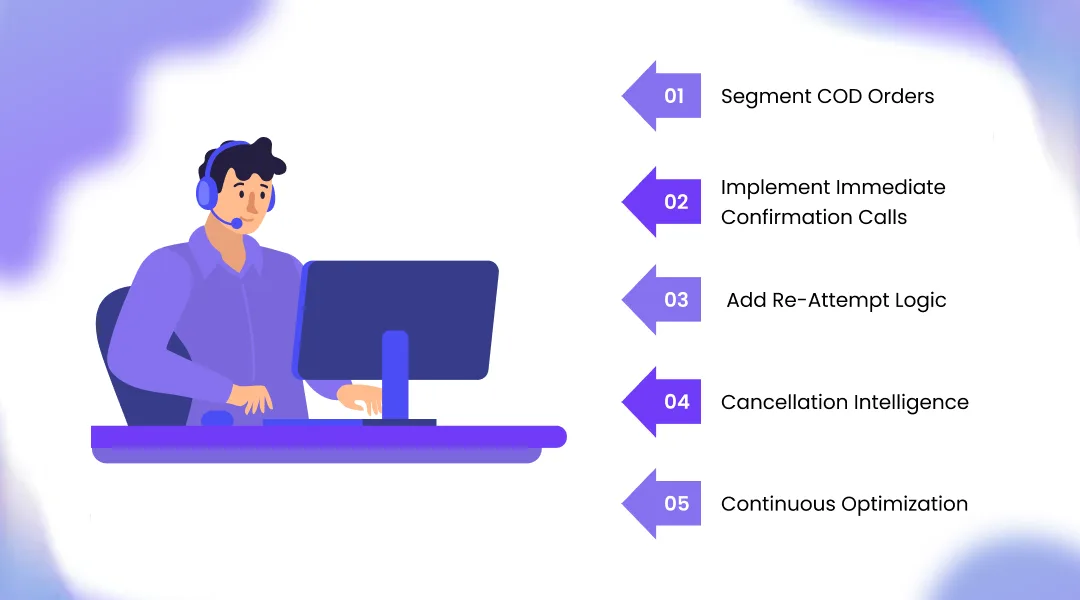
Here’s the step-by-step strategy I recommend.
Step 1: Segment COD Orders
High-value COD orders should be prioritized for confirmation.
Step 2: Implement Immediate Confirmation Calls
Don’t wait 6 hours. Confirm within 2 minutes.
Step 3: Add Re-Attempt Logic
If call not answered:
- Retry 2 times
- Trigger WhatsApp fallback
Step 4: Cancellation Intelligence
Capture why customers cancel.
Wrong size? Price issue? Address mistake?
Data improves marketing.
Step 5: Continuous Optimization
Track:
- Confirmation rate
- Cancellation rate
- RTO trend
- Call pickup percentage
The Best AI Voice Agent Platform gives analytics dashboards.
If you can’t measure it, you can’t improve it.
Conclusion
Let me leave you with this.
If your brand is doing 100+ orders per day and you’re still manually confirming COD orders, you don’t have a people problem.
You have a systems problem.
An automated call system for e-commerce sellers isn’t about AI hype.
It’s about margin protection.
It’s about predictable operations.
It’s about sleeping without checking dispatch spreadsheets at midnight.
And if you choose the right partner, whether you Hire AI Voice Agents internally or work with a voice-first company like OnDial - the impact compounds.
Less chaos. Lower RTO. Higher dispatch confidence.
Operations should feel controlled.
Not fragile.