Let me tell you something I learned the hard way.
Call centers are expensive. Not just “a bit pricey.” Brutally expensive.
When I worked on backend automation systems for telecom infrastructure years ago, I sat in more than a few operations meetings where the same question kept coming up:
“Why do our call center costs keep increasing?”
More calls. More agents. More training. More infrastructure.
And yet customer satisfaction barely improved.
Sound familiar?
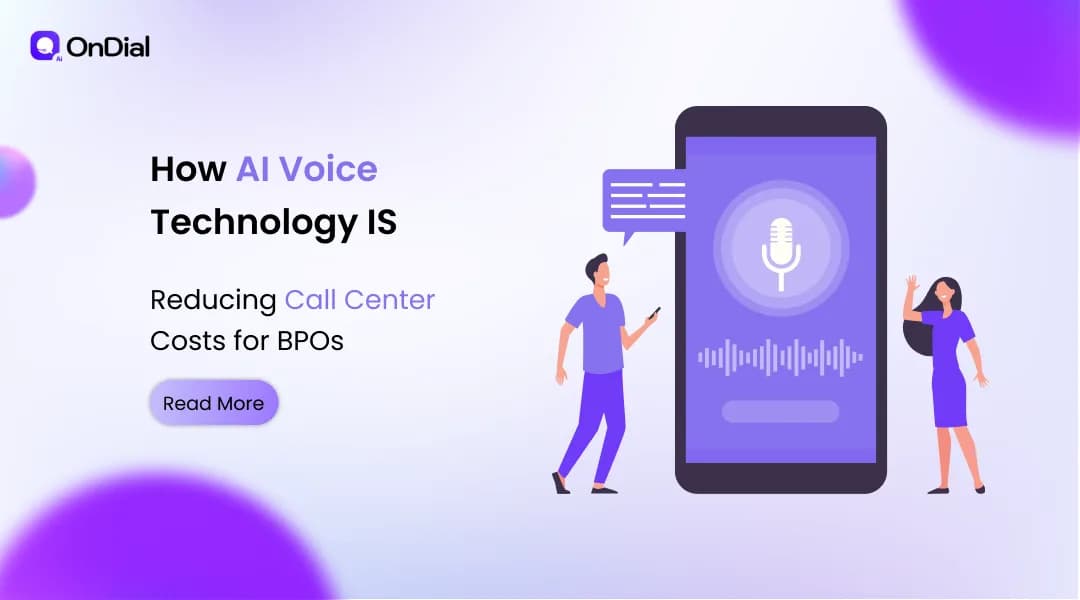
This is exactly why AI voice technology for call centers is becoming a serious conversation inside BPO boardrooms. Not because it’s trendy. But because the math finally makes sense.
The interesting part? AI voice agents aren't replacing humans the way headlines like to suggest.
They’re removing the repetitive, expensive, sanity-draining parts of customer support.
And that changes everything.
The Growing Cost Challenges in Traditional Call Centers
Let’s start with reality.
A traditional call center runs on three major cost pillars:
- Human agents
- Training and onboarding
- Infrastructure and management
Individually manageable.
Together? A financial monster.
Here’s the issue I’ve seen repeatedly.
Most customer support calls fall into predictable categories:
- Password resets
- Order tracking
- Appointment confirmations
- Billing questions
- Account verification
In many BPOs, 70% of calls are repetitive queries.
Yet every single one requires a human agent.
Think about that for a moment.
Highly trained agents spending their entire shift answering the same questions over and over again.
It’s inefficient. It’s costly. And frankly… it's unnecessary now.
What Is AI Voice Technology?
AI voice technology is essentially a conversational system that can understand speech, process intent, and respond naturally in real time.
Not robotic menus. Not “Press 1 for billing.”
Actual conversations.
Modern AI voice agents for BPO combine several technologies:
- Speech recognition
- Natural language processing
- Intent detection
- Voice synthesis
- Business logic integration
Put together, they create a system capable of handling customer calls independently.
And yes. Customers often don’t realize they’re speaking to AI.
How AI Voice Agents Work
Behind the scenes, a voice AI call typically follows this flow:
- Customer calls the support number
- AI answers instantly
- The system converts speech to text
- AI analyzes intent
- System retrieves data from CRM or backend systems
- AI responds in natural speech
The entire process takes milliseconds.
Which means responses feel conversational.
Not scripted.
Difference Between AI Voice Bots and Traditional IVR
Traditional IVR systems were designed for control.
AI voice systems are designed for conversation.
Let’s compare.
Traditional IVR
- Menu-driven
- Rigid call paths
- Limited understanding
- Frustrating user experience
AI Voice Bots
- Natural conversation
- Context awareness
- Flexible responses
- Faster resolution
If you’ve ever yelled “AGENT!” into your phone while navigating an IVR…
You already understand the difference.
How AI Voice Technology Helps BPOs Reduce Costs
Now we get to the part BPO leaders care about most.
Money.
Where exactly does AI call center automation reduce operational costs?
Let’s break it down.
Reducing Agent Workload
AI voice bots handle repetitive queries automatically.
That means human agents no longer spend time on:
- password resets
- order tracking
- appointment reminders
- payment confirmations
Instead, agents focus on complex or emotional conversations.
The result?
Smaller teams handling larger volumes.
Handling High Call Volumes Automatically
Call spikes are a nightmare in BPO operations.
A product launch. A billing issue. A holiday surge.
Suddenly the queue explodes.
Traditional response?
Hire temporary agents.
Train them.
Pay them.
Hope they perform.
AI voice agents don’t care about call spikes.
They scale instantly.
100 calls? 1,000 calls? 10,000 calls?
No staffing panic.
24/7 Customer Support Without Extra Staffing
Night shifts are expensive.
And difficult to manage.
AI voice assistants never sleep. Never call in sick. Never request overtime.
Which means businesses can offer 24/7 support without expanding their workforce.
This alone can dramatically reduce operational overhead.
Faster Query Resolution
Customers hate waiting.
Actually… they hate repeating themselves even more.
Voice AI systems connect directly to business databases.
Which means they can:
- check order status instantly
- verify account details
- schedule appointments
Average handling time drops significantly.
And shorter calls mean lower cost per interaction.
Key Cost Benefits of AI Voice Automation
Let’s talk numbers.
Because cost reduction isn’t theoretical here.
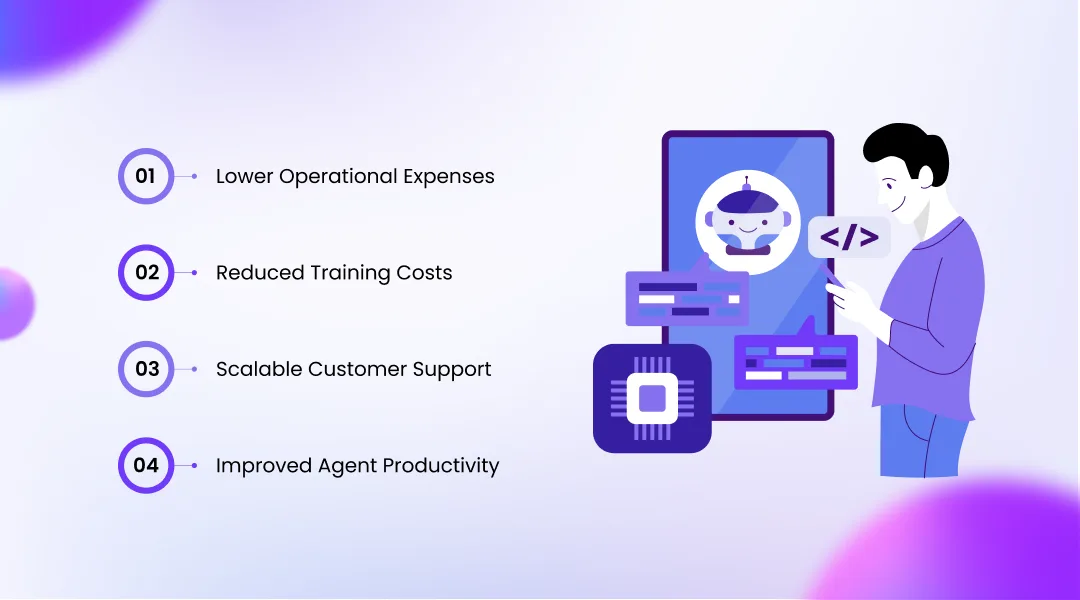
Lower Operational Expenses
Labor is the largest cost in call centers.
AI automation reduces the number of calls requiring human intervention.
Many BPOs see 30–60% automation rates once voice AI is deployed properly.
That’s a massive shift in operational economics.
Reduced Training Costs
Agent training is expensive.
New hires need weeks of onboarding.
AI voice systems don’t.
They’re trained once and improved continuously.
And when processes change?
You update the system.
Not hundreds of employees.
Scalable Customer Support
Scaling a traditional support team takes months.
Recruitment Training Quality monitoring
Voice AI scales in hours.
This is particularly useful for startups or SaaS companies experiencing rapid growth.
Improved Agent Productivity
Here’s something people often miss.
AI voice assistants make human agents better.
When repetitive calls disappear, agents handle more meaningful conversations.
Morale improves.
Productivity improves.
Customer experience improves.
Funny how that works.
Real-World Use Cases of AI Voice in BPO
AI voice technology isn’t theoretical anymore.
It’s already running inside real support operations.
Customer Support Automation
Handling FAQs, billing inquiries, account verification, and common service requests.
Appointment Scheduling
Healthcare, service providers, and logistics companies use voice AI to schedule appointments automatically.
Order Tracking Calls
Ecommerce companies receive massive volumes of “Where is my order?” calls.
Voice AI solves that instantly.
Banking & Fintech Support
Balance checks, transaction confirmations, and fraud alerts can all be handled via AI voice systems.
Telecom Customer Service
Telecom providers deal with millions of support requests daily.
Voice AI systems dramatically reduce call queue pressure.
(Quick side note: one of the most fascinating deployments I’ve seen was voice AI used in property inquiries — similar to AI Voice Agents for Real Estate, where calls about listings are handled automatically.)
Features to Look for in an AI Voice Platform
Not all voice AI systems are equal.
If I were evaluating a platform today, here’s what I’d check first.
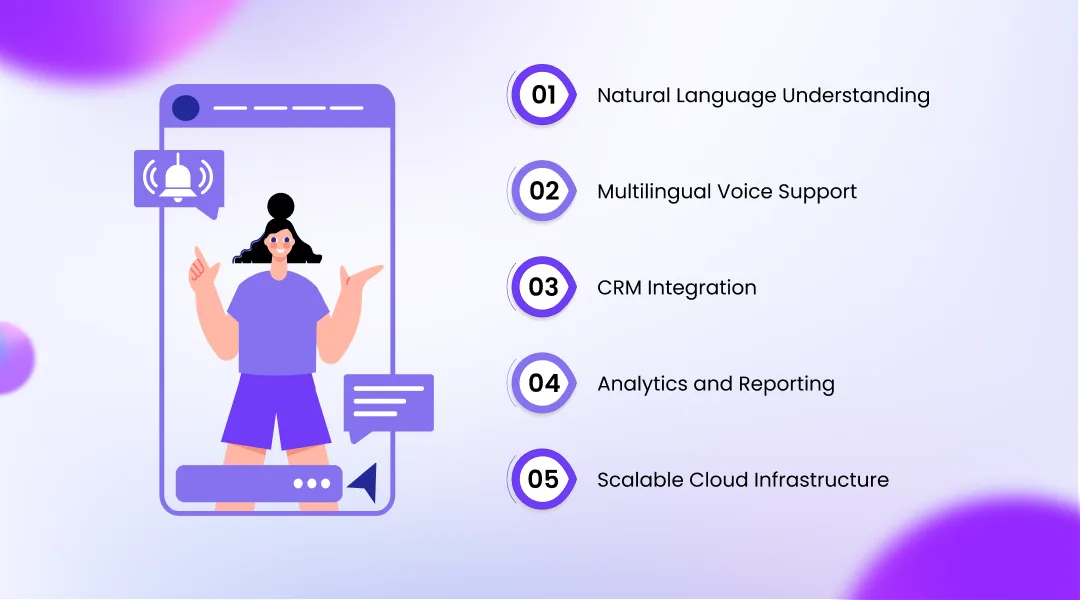
Natural Language Understanding
The AI must interpret natural speech - accents, variations, and informal language included.
Otherwise the experience breaks instantly.
Multilingual Voice Support
Especially important for India and global BPO operations.
Customers prefer speaking their native language.
CRM Integration
Voice AI should connect directly to existing tools:
- CRM platforms
- ticketing systems
- databases
Without this, automation becomes shallow.
Analytics and Reporting
Call insights are gold.
You want dashboards showing:
- call reasons
- resolution rates
- escalation patterns
These insights improve both AI and human workflows.
Scalable Cloud Infrastructure
Voice systems must handle large call volumes without downtime.
This is where platforms like OnDial focus heavily, building reliable voice AI architecture for real-world deployments.
Future of AI Voice Technology in the BPO Industry
Let me be blunt.
Voice AI adoption in BPO isn’t a trend.
It’s an operational shift.
Over the next five years we’ll see:
- AI-first call centers
- hybrid AI + human support teams
- personalized voice assistants for customer service
And the BPOs that adopt early?
They’ll operate at significantly lower cost structures.
Which gives them a competitive advantage that’s hard to catch.
Conclusion
I’ve spent enough time around customer support infrastructure to know this:
Most call center inefficiencies aren't caused by people.
They’re caused by outdated systems.
AI voice technology fixes that.
It removes repetitive tasks, reduces operational costs, and allows human agents to focus on conversations that actually require empathy and judgment.
For BPOs looking to scale without exploding budgets, AI voice automation in customer service isn’t optional anymore.
It’s the next logical step.
And the companies that implement it thoughtfully, with human experience at the center — will define the future of customer support.