I’ve spent half my career fixing automation that looked brilliant in a sales demo and disastrous on a Monday morning.
You probably have scars too.
Maybe you inherited an IVR tree so confusing customers keep pressing “0” like it’s a life raft. Maybe hiring can’t keep up with call volume. Maybe your CFO wants costs down while CSAT goes up.
Magic. Right.
This is usually where someone suggests AI voice assistants for business and half the room gets excited while the other half quietly Googles, “how badly can this go wrong?”
Fair.
I’ve been inside enough deployments to tell you the truth: when done right, voice AI in operations can fundamentally reshape how companies run. When done poorly, it becomes an expensive apology.
Let’s talk about the difference.
What Are AI Voice Assistants for Business?
At a practical level, an enterprise AI voice assistant is software that can understand speech, decide what to do, and respond naturally over a phone line.
But definitions are cheap. Outcomes matter.
Here’s the mental model I give every leadership team.
Old IVR: rigid menus, keypad gymnastics, no memory. Chatbots: text-first, often scripted, helpful but limited in real-time nuance. Modern voice AI: listens, interprets intent, accesses systems, completes tasks, learns.
It’s the shift from “route the call” to “resolve the need.”
That’s business voice automation.
And yes, it can handle real conversations. Not sci-fi conversations. Real ones. With interruptions, accents, background noise, and humans who don’t follow scripts (because humans never do).
I’ve watched an AI phone assistant reschedule appointments, qualify leads, verify identities, and escalate edge cases in seconds.
Seconds.
Where Traditional Operations Break
Let me be blunt.
Most support models weren’t designed for today’s demand curves.
They were built for predictable hours, stable staffing, and patient customers. None of which exist anymore.
Here’s what I see repeatedly:
- Peak hours drowning agents
- Long hold times
- Training gaps between shifts
- Repetitive queries burning morale
- High turnover
- Expensive overflow vendors
And inconsistency. Huge inconsistency.
Two customers call with the same issue. One gets a veteran. The other gets a new hire on day three.
Guess who leaves happy?
Exactly.
This is why automated customer support voice systems are gaining ground. They standardize the baseline while humans handle complexity.
Key Ways AI Voice Assistants Are Transforming Businesses
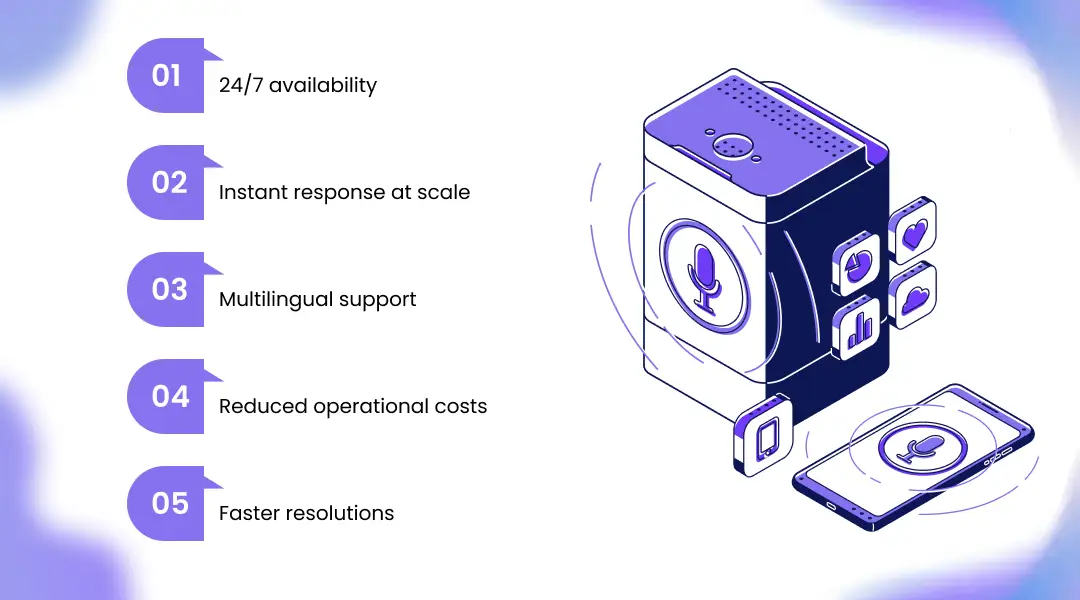
24/7 availability
Customers don’t care about your office hours. They care about their emergency.
An AI receptionist doesn’t sleep, call in sick, or quit mid-quarter.
I once saw a healthcare client eliminate 38% of voicemail backlog in the first month simply by answering nights and weekends.
No drama. Just coverage.
Instant response at scale
Ten calls or ten thousand. The wait time stays near zero.
Think about what that does to abandonment rates.
Multilingual support
Global audience. Local expectations.
Modern speech AI solutions can switch languages mid-conversation. (Try doing that with a hiring plan.)
Reduced operational costs
Yes, finance loves this part.
But the bigger win is reallocating humans to higher-value work instead of password resets and store hours.
Faster resolutions
Because the system integrates with CRM, ticketing, scheduling, billing.
No swivel chair. No transfers.
Done.
Impact Across Departments
The mistake I see? Teams think this is only for support.
It’s not.
Customer support
High-volume, repeatable interactions become prime candidates for AI call handling, while agents focus on escalations and empathy moments.
Sales & lead qualification
A voice bot for business can capture intent, budget, and urgency before a rep ever picks up.
Imagine your closers starting every conversation informed.
Appointment booking
Reschedules. Reminders. Confirmations.
Routine. Perfect for a virtual voice assistant for companies.
Internal helpdesks
Password resets at 2 a.m. VPN access. Policy questions.
Why wake a human?
Real ROI: Time, Money & Productivity Gains
Someone always asks me, “What’s the real return?”
Here’s my honest answer.
ROI shows up in three places:
Time saved. Labor optimized. Customer frustration reduced.
I’ve seen organizations cut average handling time by double digits within weeks. I’ve watched first-contact resolution jump because intelligent call routing sends people to the right place immediately.
And morale?
Up.
Because humans stop doing robotic work.
Funny how that works.
How to Successfully Implement a Voice AI System
Here’s where projects live or die.
Not technology.
Change management.
You need clean data, mapped intents, defined escalation paths, and metrics that go beyond containment rate.
You also need honesty about failure scenarios.
(Yes, the AI will misunderstand someone. Welcome to communication.)
The winners iterate fast. Weekly improvements. Continuous tuning.
And they involve frontline agents early, because those people know the calls better than anyone in procurement.
Ignore them and you pay later.
Conclusion
If you’re skeptical, good. You should be.
But skepticism should lead to investigation, not paralysis.
The modern AI phone assistant isn’t about replacing people. It’s about designing operations that finally match the speed and expectations of the real world.
I’ve seen disasters.
I’ve also seen transformations that made executives wonder why they waited so long.
The difference was intention, execution, and choosing the right builders.
Choose carefully.