Let me guess.
Your support team is drowning.
Tickets piling up. Calls going unanswered. Customers getting impatient. And somewhere in a meeting, someone said: “Let’s just add AI.”
I’ve seen this play out dozens of times. And here’s the uncomfortable truth:
Most businesses don’t need “AI.” They need better conversations at scale.
That’s where AI voice agents come in, not as a shiny upgrade, but as a practical solution to a very human problem: communication bottlenecks.
But do they actually work?
Or are they just glorified IVR systems pretending to be smart?
Let’s break it down properly.
How AI Voice Agents Work
At a high level, AI voice agents mimic how humans process conversations. But under the hood? It’s a tightly orchestrated system of technologies working together in milliseconds.
Input (Customer Voice)
Everything starts with speech recognition AI.
A customer speaks. The system captures audio. Converts it into text.
Sounds simple. It’s not.
Accents. Background noise. Slang. Emotion. This is where most systems fall apart.
Good AI voice agents don’t just “hear.” They interpret.
Processing (AI + NLP)
Now the real work begins.
The system uses natural language processing voice models to understand intent.
Not keywords. Intent.
There’s a difference between:
- “I want to cancel my order”
- “Why hasn’t my order arrived yet?”
Same frustration. Different action.
This is where machine learning customer service systems shine—they learn from past interactions and improve over time.
(And yes, they also mess up sometimes. I’ve seen an AI try to “refund” a customer asking for store hours. Not pretty.)
Output (Response Generation)
Once the intent is clear, the AI responds.
This could be:
- A spoken answer
- A triggered workflow
- A handoff to a human
Modern systems use conversational AI customer service logic to make responses feel… natural.
Not robotic. Not scripted. Just helpful.
At least, that’s the goal.
Key Benefits of AI Voice Agents in Customer Support
Let’s cut through the noise.
Here’s what actually matters.
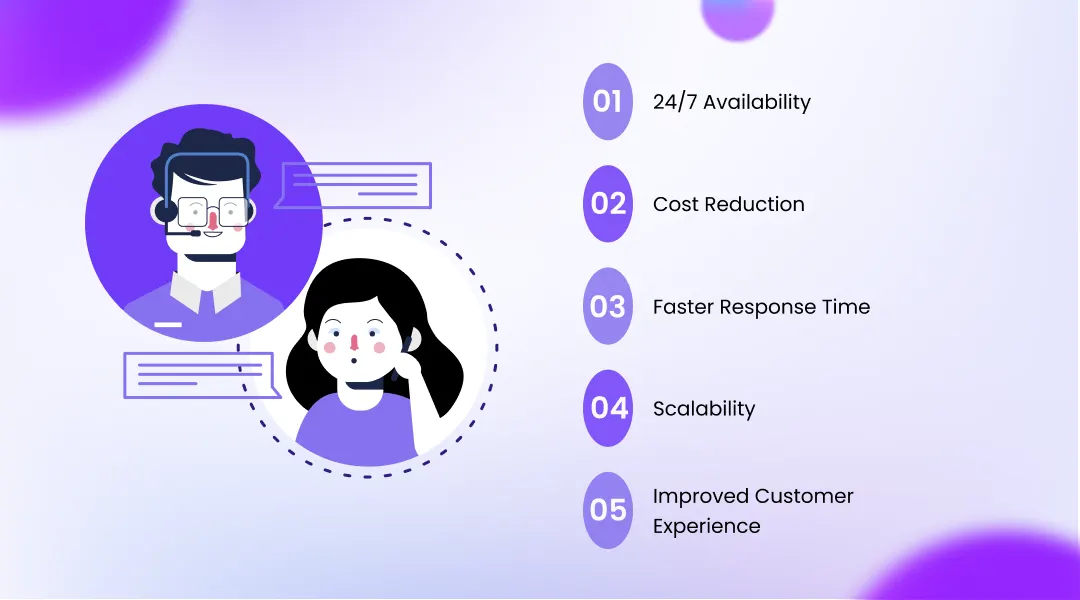
24/7 Availability
Humans sleep. AI doesn’t.
Simple advantage. Massive impact.
Cost Reduction
Hiring, training, managing support teams—it adds up fast.
AI voice agents reduce repetitive workload.
Not replace people. Reduce waste.
Faster Response Time
Customers hate waiting.
Even 30 seconds feels like forever when you’re frustrated.
AI responds instantly. Every time.
Scalability
One agent can handle thousands of conversations simultaneously.
Try doing that with a human team.
Improved Customer Experience
This is the tricky one.
Because bad AI? Ruins experience.
But good AI—well-designed, trained, and integrated—feels like magic.
Real-World Use Cases
Let’s make this concrete.
E-commerce Order Tracking
“Where is my order?”
This one question can eat up 40% of support bandwidth.
AI handles it instantly.
Banking & Finance Support
Balance inquiries. Transaction alerts. Fraud detection.
Speed matters here. Accuracy matters more.
Healthcare Appointment Booking
Patients don’t want to navigate complex systems.
They just want to book. Reschedule. Confirm.
Voice makes it frictionless.
SaaS Customer Onboarding
New users always have questions.
AI voice agents guide them in real time.
(And yes, this reduces churn more than most people expect.)
AI Voice Agents vs Traditional Customer Support
Let’s be honest.
This isn’t a fair fight.
Cost Comparison
Human teams = recurring cost AI systems = upfront + optimization
Over time? AI wins.
Speed & Efficiency
Humans are thoughtful. But slow.
AI is instant. But limited.
The best systems combine both.
Human Dependency
Traditional support relies entirely on people.
AI reduces dependency—but doesn’t eliminate it.
And that’s a good thing.
AI Voice Agents vs Chatbots
Quick question.
When was the last time you enjoyed chatting with a chatbot?
Exactly.
Voice vs Text Experience
Voice feels natural.
Text feels… transactional.
Voice builds trust faster.
When to Use What
- Use chatbots for simple, structured tasks
- Use AI voice agents for dynamic, conversational support
Don’t overcomplicate it.
Challenges & Limitations
Now the part most companies conveniently ignore.
Accent Understanding
India alone has dozens of accents.
Global customers? Even more.
Accuracy isn’t perfect.
Complex Queries
AI struggles with layered, emotional, or ambiguous problems.
Humans still win here.
Data Privacy Concerns
Voice data is sensitive.
If you’re not thinking about compliance—you’re already behind.
Future of AI Voice in Customer Support
This is where things get interesting.
Hyper-Personalization
AI will remember context across conversations.
Not just what you said—but how you said it.
Multilingual AI
One system. Multiple languages.
This is huge for markets like India.
Emotion Detection
Yes, AI is starting to detect tone, stress, urgency.
Creepy? Maybe.
Useful? Definitely.
How to Implement AI Voice Agents in Your Business
Here’s where most businesses get stuck.
So I’ll keep it practical.
Choose Platform
Pick a solution that aligns with your use case.
(Not the one with the flashiest demo.)
Integration Steps
- Connect CRM
- Train on real conversation data
- Define workflows
- Test aggressively
Then test again.
Best Practices
- Start small
- Focus on high-volume queries
- Keep humans in the loop
- Continuously optimize
And one more thing.
Don’t expect perfection on day one.
Conclusion
AI voice agents aren’t magic.
They won’t fix broken processes. They won’t replace great support teams.
But when done right?
They remove friction. They scale conversations. They give your team breathing room.
And that’s the real transformation.
Not replacing humans.
Supporting them better.