I’ve watched businesses spend millions on marketing, analytics, and automation—then quietly lose customers because no one answered the phone.
Not because they didn’t care. Because they couldn’t keep up.
Calls pile up. Agents burn out. IVRs frustrate everyone involved. And somewhere between “Press 1 for sales” and “Your call is important to us,” trust evaporates.
This is where most conversations about voice automation go wrong. They obsess over technology and ignore the human moment on the other end of the line—the second when a customer decides whether your business is competent, caring, or wasting their time.
An AI Call Assistant, done right, doesn’t sound like automation. It sounds like readiness. It answers when humans can’t. It listens when scripts fail. And it responds with context instead of canned replies.
I’ve seen voice AI implemented poorly and I’ve seen it quietly transform sales pipelines, customer support teams, and entire operations. The difference isn’t the algorithm. It’s the intent behind it.
In this article, I’ll break down what an AI Call Assistant actually is, why traditional IVRs are hitting a wall, and how companies like OnDial are building voice systems that scale communication without stripping it of empathy.
What Is an AI Call Assistant?
Let’s strip away the buzzwords.
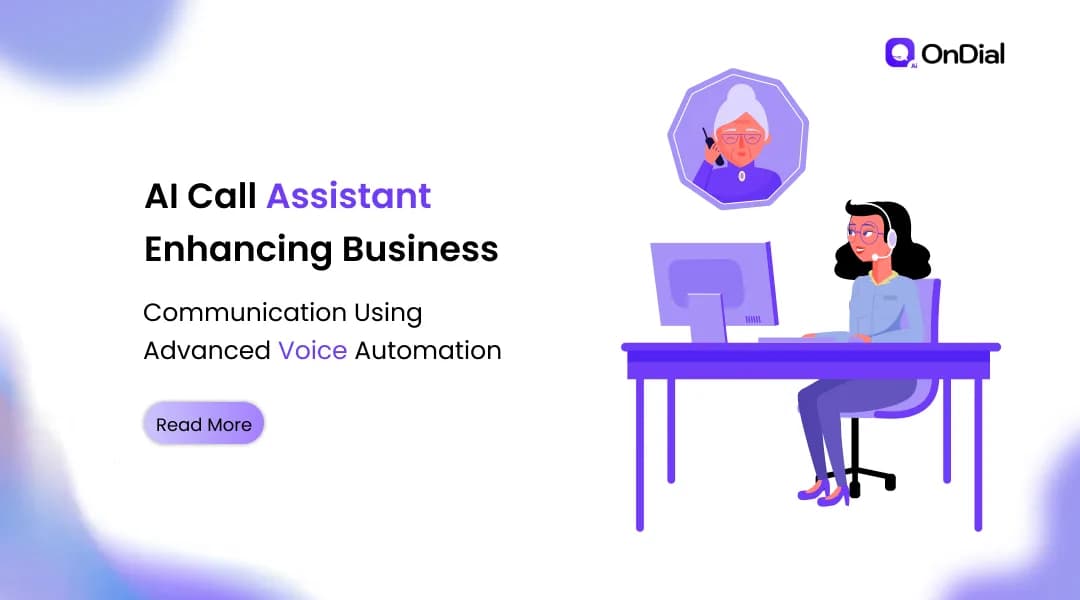
An AI Call Assistant is a software-based voice system that can answer, understand, respond to, and act on phone calls, without rigid scripts or keypad gymnastics. It listens. It interprets intent. It responds like a trained agent would. Sometimes better.
The core idea
Instead of forcing callers to adapt to your system, the system adapts to the caller.
That’s the difference. And it’s not subtle.
How AI voice assistants work (without the fluff)
When someone places AI Phone Calls, inbound or outbound - the system follows a layered process:
- Automatic Speech Recognition (ASR) converts voice to text
- Natural Language Processing (NLP) figures out what the caller actually means
- Machine Learning models decide the best response or next action
- Text-to-Speech (TTS) responds in a human-like voice
All of this happens in milliseconds.
No menus. No “press 3 for disappointment.”
The role of NLP, ASR & Machine Learning
Here’s the part most vendors gloss over (I won’t):
- ASR quality decides whether accents and regional languages are respected
- NLP depth determines if the system understands intent, not just keywords
- ML training data defines whether responses improve or repeat mistakes
At OnDial, this stack is built around real-world Indian and global voice data—not lab-perfect audio samples. That matters more than most people realise.
Why Businesses Need AI Call Assistants Today
I’ll be blunt.
If your business still treats voice calls as a cost centre instead of a strategic channel, you’re bleeding opportunity.
Rising customer expectations
Customers don’t compare you to your competitors anymore. They compare you to the last good experience they had anywhere.
That includes response time. Tone. Memory. Context.
Voice automation for business is no longer optional—it’s expected.
High call volumes & agent burnout
I’ve sat with call center managers staring at dashboards where:
- Call queues spike unpredictably
- Agents rush conversations just to survive the shift
- Quality drops. Then attrition rises.
AI call automation doesn’t replace humans. It protects them.
(Yes, that sentence was intentional.)
The cost vs efficiency trap
Hiring more agents scales linearly. AI-powered call assistants don’t.
That’s the uncomfortable math most finance teams eventually face.
Key Features of an AI Call Assistant
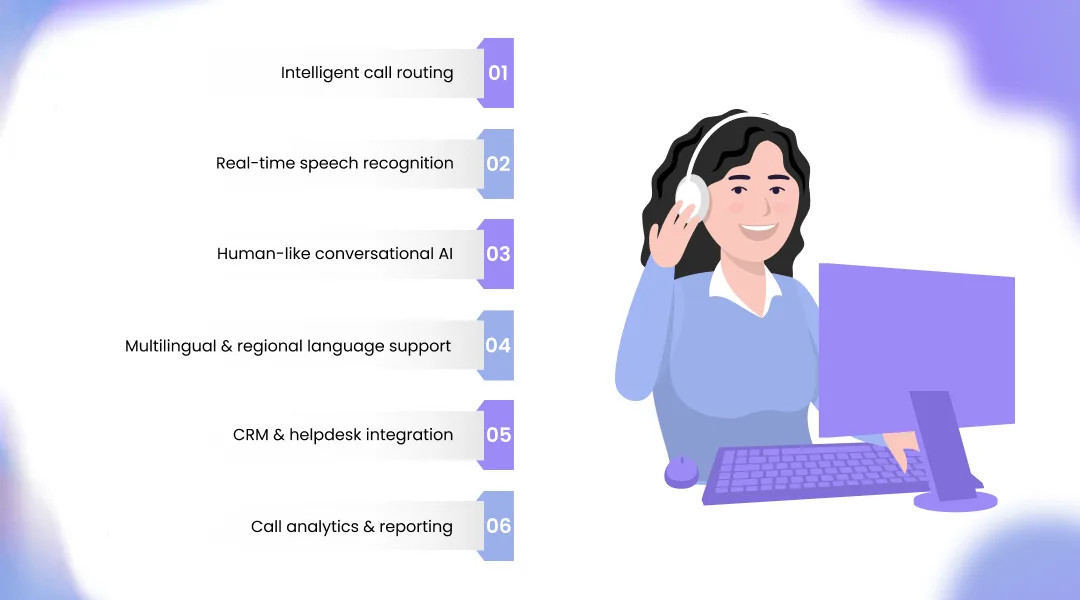
Not all AI voice assistants are equal. Some are glorified IVRs with better voices. Others are actual conversational systems.
Here’s what separates the real ones.
Intelligent call routing
Calls are routed based on intent, not menu choices.
Sales inquiry? Routed instantly. Support issue? Context passed before escalation.
No caller repetition. Ever.
Real-time speech recognition
This is where most systems fail quietly.
A strong AI call assistant handles:
- Accents
- Background noise
- Interruptions
- Natural pauses
If it can’t do that, it shouldn’t answer Customer Calls.
Human-like conversational AI
People interrupt. They ramble. They change their minds.
A usable Voice Assistant doesn’t panic when that happens. It adapts.
Multilingual & regional language support
In India especially, this is non-negotiable.
OnDial’s AI Voice Assistants are designed for real linguistic diversity—not checkbox language support.
CRM & helpdesk integration
If your AI can talk but can’t log, tag, or update records… It’s decorative.
True AI call assistant software integrates with CRMs, ticketing tools, and internal systems through APIs.
Call analytics & reporting
Every call generates insight:
- Intent trends
- Drop-off points
- Agent handoff quality
- Conversion signals
Data beats gut feeling. Every time.
Benefits of AI Call Assistants for Businesses
Let’s talk outcomes. Not features.
24/7 availability
Your business sleeps. Your customers don’t.
An AI call assistant answers every call. Every time.
Reduced operational costs
Less overtime. Lower attrition. Fewer missed opportunities.
This is where CFOs start paying attention.
Faster response time
Speed isn’t just polite—it’s profitable.
Milliseconds matter in voice interactions.
Consistent customer experience
Humans have bad days. AI doesn’t.
That consistency builds trust at scale.
Improved sales & lead conversion
AI outbound calling systems don’t forget follow-ups. They don’t rush qualification. They don’t improvise the wrong pitch.
That’s why sales teams quietly love them.
Scalable communication infrastructure
Whether it’s 100 calls or 100,000, business voice automation scales without chaos.
Use Cases of AI Call Assistants Across Industries
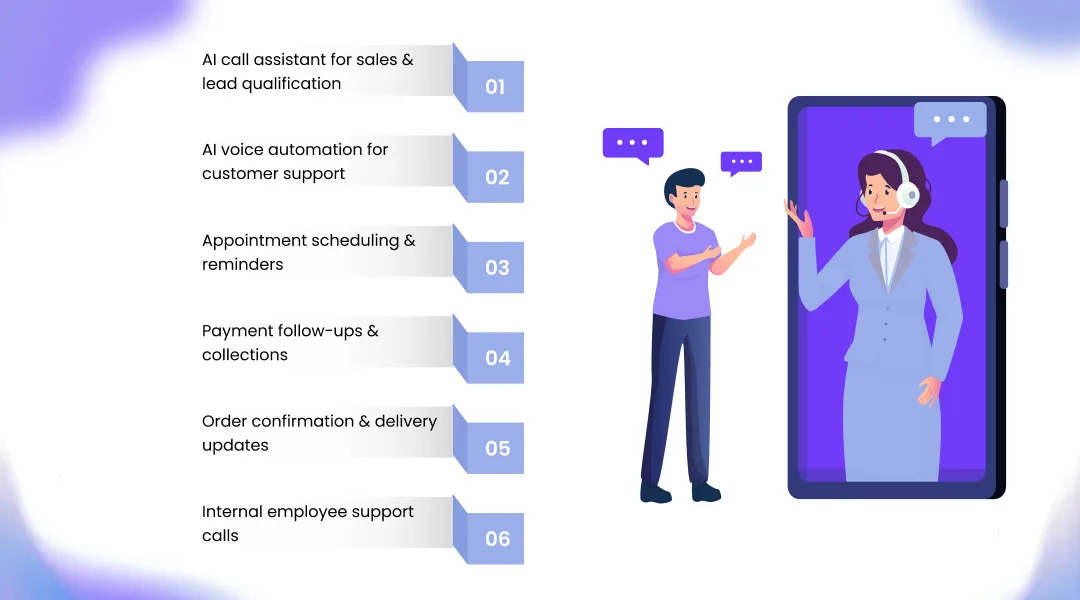
This is where theory meets reality.
AI call assistant for sales & lead qualification
Inbound leads are qualified instantly. Outbound campaigns run without manual dialling.
The Role of AI Call Agents here is simple: filter signal from noise.
AI voice automation for customer support
Balance resets. Ticket status. Complaint intake.
Handled cleanly before a human ever gets involved.
Appointment scheduling & reminders
Healthcare. Real estate. Consulting.
No-shows drop. Schedules stabilize.
Payment follow-ups & collections
Neutral tone. Perfect timing. Zero emotion.
That’s exactly what sensitive calls need.
Order confirmation & delivery updates
E-commerce and logistics thrive here.
Clear communication reduces support tickets downstream.
Internal employee support calls
IT resets. HR queries. Policy clarifications.
Yes, AI voice assistants work internally too.
AI Call Assistant vs Traditional IVR Systems
This comparison matters more than most buyers admit.
Static IVR limitations
- Fixed menus
- No memory
- Zero learning
IVRs don’t understand. They route.
Conversational AI advantages
AI call assistants understand intent, context, and history.
They improve with usage. IVRs don’t.
Personalisation & intelligence comparison
An AI IVR solution can greet returning callers by name. An IVR… can’t.
Enough said.
How AI Call Assistants Enhance Customer Experience
Customer experience isn’t a slogan. It’s cumulative.
Natural conversations
No robotic pacing. No keyword traps.
Just conversation.
Reduced wait times
Most issues never hit a queue.
That alone changes perception.
First-call resolution
FCR improves when context isn’t lost between systems.
AI remembers. Humans appreciate that.
Omnichannel voice integration
Voice doesn’t live alone anymore.
It connects with chat, CRM, and ticketing, forming a single narrative.
Choosing the Right AI Call Assistant Solution
This is where many teams get burned.
Cloud-based vs on-premise
Cloud scales faster. On-premise offers control.
There’s no universal answer, only trade-offs.
Security & compliance
GDPR. HIPAA. Audit logs.
If a vendor dodges these questions, walk away.
Customisation & scalability
Templates are fine. Rigid systems aren’t.
OnDial’s strength lies in tailored AI voice automation, not one-size-fits-all bots.
Integration capabilities
If APIs are an afterthought, so is reliability.
Pricing & ROI
Ask this question directly:
“What business metric improves in the first 90 days?”
Silence is an answer.
Future of AI Voice Automation in Business Communication
Voice AI isn’t slowing down. It’s getting quieter—and smarter.
Predictive voice AI
Systems will act before customers ask.
Emotion & sentiment analysis
Tone detection changes escalation logic.
Yes, machines can sense frustration now.
Fully autonomous call workflows
From call to closure, without handoffs.
Hyper-personalised conversations
Not creepy. Contextual.
There’s a difference.
Conclusion
I’ve watched businesses fight automation until exhaustion forced their hand.
The smart ones didn’t automate to cut costs. They automated to respect attention, their customers’ and their teams’.
An AI Call Assistant, done right, doesn’t remove humanity from communication. It removes friction.
And that’s a trade worth making.