I’ve spent a good chunk of my career inside sales floors and contact centres. Headsets everywhere. Dashboards glowing red. Managers asking the same question every hour: “Why didn’t we call this lead sooner?”
The uncomfortable truth? Sales doesn’t fail because teams don’t care. It fails because humans can’t scale phone calls.
That’s where the AI Call Assistant enters the picture. Not as a shiny toy. Not as a threat to jobs. But as a very practical response to a very old problem.
Let me walk you through it - without fluff, without buzzwords, and without pretending this is magic.
What Is an AI Call Assistant?
Let’s strip this down to basics.
An AI Call Assistant is a voice-based system that can make and receive phone calls, understand what the person on the other end is saying, respond intelligently, and take action, without a human agent being present.
Not prerecorded menus. Not “Press 1 for sales.”
Actual conversations.
Core functionality
- Calls leads automatically
- Qualifies them based on predefined criteria
- Answers questions in natural language
- Updates CRMs after every interaction
- Triggers follow-ups, reminders, or escalations
It handles Customer Calls that don’t need human judgment—but absolutely need speed and consistency.
How AI voice assistants work (quick, honest version)
Under the hood, three systems work together:
- Speech Recognition – Converts spoken words into text
- Natural Language Processing (NLP) – Understands intent, not just keywords
- Machine Learning – Improves responses based on past interactions
When someone says, “Call me tomorrow afternoon,” the system doesn’t panic. It schedules it. Automatically.
That’s the difference between a script and a Voice Assistant.
The Evolution of Automated Voice Call Solutions
I still remember building IVR flows that looked like subway maps. Endless branches. Dead ends. Customer rage.
IVR wasn’t evil. It was just limited.
From IVR to conversational AI
- Then: Rigid menus, button presses, zero context
- Now: Free-flowing conversation, memory, intent recognition
Enterprises moved on because customers did. People talk to phones now. They don’t navigate them.
And once businesses saw conversational systems handling AI Phone Calls better than entry-level agents? Momentum was inevitable.
Here’s the quiet reason IVR died: It optimized routing. AI optimizes resolution.
How AI Call Assistants Transform Sales Support Operations
This is where things get real.
Automated lead qualification
Every sales leader knows the math:
- 100 leads
- 40 unreachable
- 30 unqualified
- 20 slow follow-ups
- 10 real opportunities
An AI Call Assistant filters the noise before humans ever pick up the phone.
It asks questions. Listens. Scores intent. Pushes only sales-ready leads forward.
Instant follow-up calls
Speed matters more than persuasion.
I’ve seen conversion rates double simply because the first call happened in under 60 seconds.
Humans can’t do that. Machines can.
Appointment scheduling & reminders
No back-and-forth. No calendar chaos.
The assistant books meetings, confirms them, and reminds prospects—politely, consistently, and without ego.
Post-sales engagement
Upsells. Renewals. Feedback.
These calls matter. They just don’t need a senior rep every time. This is where AI Voice Assistants quietly protect revenue.
Key Features of an AI Call Assistant for Enterprises
Not all systems are created equal. I’ve seen impressive demos collapse in real environments.
Here’s what actually matters.
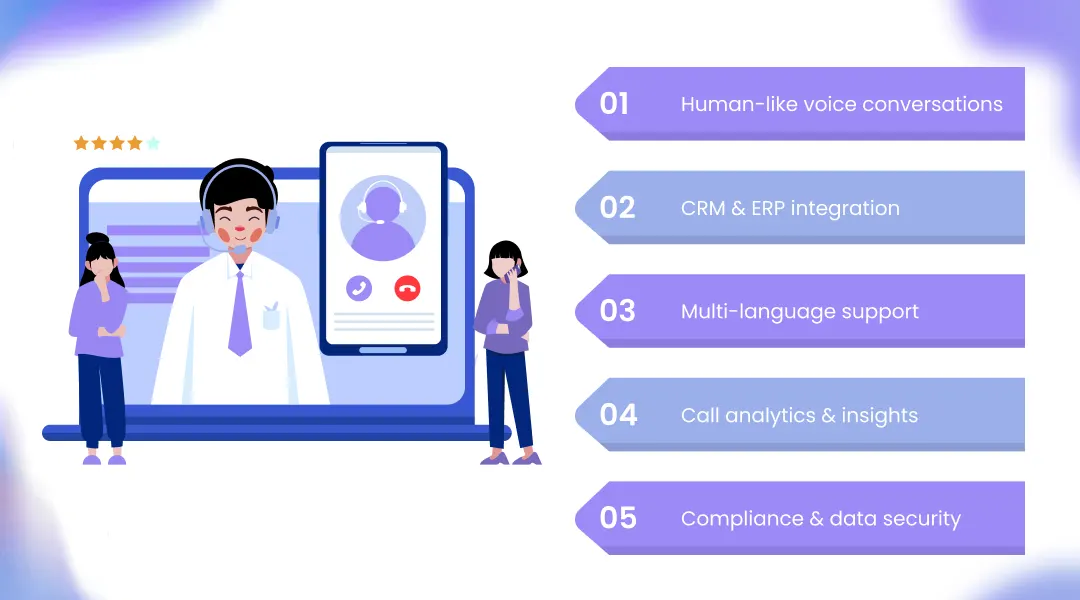
Human-like voice conversations
If it sounds robotic, trust dies instantly.
Good systems pause. Clarify. Adapt tone. Great ones sound… normal.
CRM & ERP integration
If it doesn’t update your CRM, it doesn’t exist.
Enterprise-grade assistants sync with sales pipelines, tickets, and workflows. This is where CRM-integrated AI calling stops being optional.
Multi-language support
India, the US, the Middle East, enterprises don’t operate in one accent.
Language flexibility isn’t a feature. It’s survival.
Call analytics & insights
Every conversation becomes data:
- Drop-off points
- Objection patterns
- Intent signals
This is where sales strategy actually improves.
Compliance & data security
Especially for BFSI and healthcare.
Consent logging. Call recording controls. Data residency. If a vendor can’t explain this clearly, walk away.
Benefits of AI Call Assistants for Sales-Driven Enterprises
Let’s talk outcomes, not theories.
Increased call efficiency
Thousands of calls. Zero fatigue. No Mondays.
Reduced operational costs
Fewer agents doing repetitive work. More agents doing high-value conversations.
Higher lead conversion rates
Because speed + consistency beats charm nine times out of ten.
24/7 sales availability
Your prospects don’t work your hours. Your AI does.
Consistent customer experience
No bad days. No skipped scripts. No memory lapses.
This is why enterprises now treat voice automation as infrastructure, not experimentation.
AI Call Assistant Use Cases Across Industries
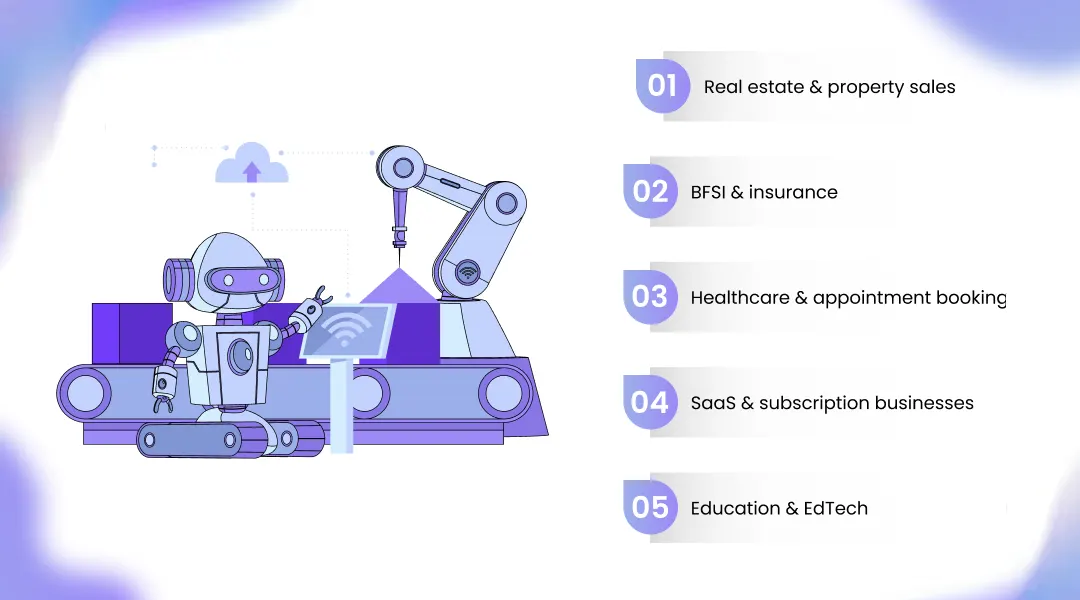
Real estate & property sales
- Instant inquiry follow-ups
- Site visit scheduling
- Price and availability updates
Missed calls here mean lost deals. Period.
BFSI & insurance
- Policy explanations
- Renewal reminders
- Lead qualification
Security and accuracy matter more than small talk.
Healthcare & appointment booking
- Scheduling
- Reminders
- Follow-ups
Patients appreciate clarity. And punctuality.
SaaS & subscription businesses
- Trial follow-ups
- Onboarding calls
- Renewal nudges
Predictable revenue loves predictable conversations.
Education & EdTech
- Admission counselling
- Course reminders
- Payment follow-ups
This is where the Role of AI Call Agents becomes obvious: scale empathy, not pressure.
AI Call Assistant vs Traditional Sales Calling
Let’s be blunt.
Cost comparison
Humans scale linearly. AI scales exponentially.
Scalability & performance
Hiring 50 agents takes months. Launching 50,000 calls takes minutes.
Accuracy & response speed
AI doesn’t forget talking points. It doesn’t “get back later.”
Does this replace humans? No.
It replaces wasted human effort.
How to Choose the Right AI Call Assistant Solution
This is where many teams get burned.
Customisation capabilities
If every business sounds the same, customers notice.
Platforms like OnDial stand out because they build tailored flows—not templates pretending to be strategy.
Voice quality & language support
Test it. Loud environments. Different accents. Real scenarios.
Integration readiness
CRMs. Dialers. Analytics stacks. If it takes months, it’s not enterprise-ready.
Pricing & scalability
Beware “cheap per minute” models that collapse at scale.
Sometimes the Best AI Voice Agent Platform isn’t the loudest, it’s the one that grows quietly with you.
(And yes, this is where choosing the Best AI Development Company actually matters.)
Future of AI Call Assistants in Enterprise Sales
Here’s what I’m seeing already.
Hyper-personalised voice conversations
Tone, timing, and messaging adapted per prospect.
Predictive sales calling
Systems deciding who to call and when—before reps even ask.
AI-driven revenue intelligence
Calls feeding forecasts. Conversations shaping strategy.
This isn’t about replacing sales. It’s about finally giving sales the system it deserved all along.
Conclusion
If you’re still thinking of an AI Call Assistant as a novelty, you’re already late.
Enterprises don’t adopt this because it’s impressive. They adopt it because it’s practical.
Because AI Phone Calls don’t get tired. Because follow-ups don’t slip. Because growth finally stops depending on who remembered to dial.
And companies like OnDial? They’re not selling software. They’re fixing communication - at scale.